The black swan
A black swan, in Nassim Taleb’s sense, is a rare event that is a huge surprise, carries enormous impact, and — only afterwards — gets explained as if it had been predictable. Because they sit outside past experience, black swans dominate history while staying invisible to models built on the ordinary.
- 1 min read
- 1 book teaches this
- 5 linked ideas
How does the black swan work?
Most forecasting extrapolates from what has already happened, so it’s blind to the unprecedented. Yet in domains with fat tails, a single extreme event can outweigh all the normal ones combined. Add hindsight, which makes the shock look foreseeable after the fact, and we systematically underestimate how much the rare runs the show.
You can't know which rare shock arrives — so build so that no single one can ruin you.
How do you use the black swan?
- Building in redundancy and margin so no single surprise can be fatal, since you can’t predict which one.
- Distrusting precise forecasts in fat-tailed domains — markets, pandemics, technology.
- Positioning for asymmetry: cap the downside, stay exposed to unexpected upside.
What does the black swan look like in practice?
The 2008 financial crisis was, for most, a black swan: risk models built on decades of “normal” data had no room for it, its impact was vast, and afterwards a tidy story made it seem obvious all along. The models weren’t merely wrong — they were blind to the events that mattered most.
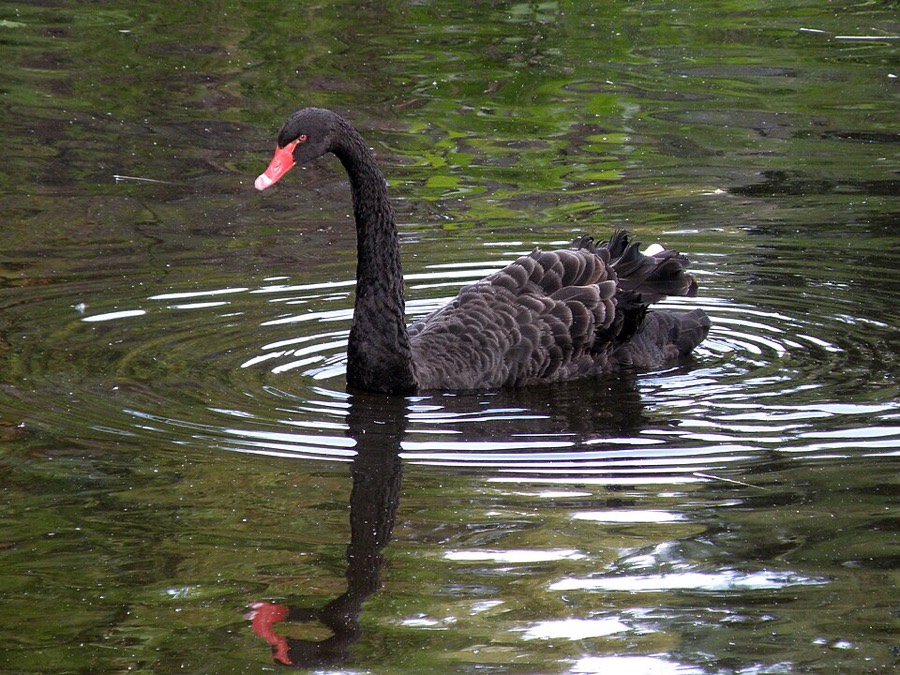
Black swan (Cygnus atratus) · photo Alina Zienowicz · CC BY-SA 3.0
Where does the black swan fail?
The label is often misused for events that were merely ignored, not truly unforeseeable — and calling something a black swan can excuse a failure better thinking would have caught. It’s a reason to build robustness against the unknown, not an alibi for missing the knowable.
- Swans are observer-relative — the crash that stuns one analyst was on another's dashboard — so the label describes your information, not the world.
- It prescribes robustness without pricing it; insuring against every tail can cost more than the tails themselves.
- In thin-tailed domains — dice, actuarial tables, physical tolerances — extremes are bounded and the framework adds little.
The counter-model: Antifragility — The black swan diagnoses exposure to rare shocks; antifragility is the design answer — build things that gain from volatility rather than merely predicting it.
How do you apply the black swan, step by step?
- For a plan you depend on, list the assumptions that must hold for it to work.
- Ask what happens if the largest assumption fails completely, however unlikely that feels.
- Sort your exposures into fragile (blow up), robust (survive), and antifragile (benefit).
- Cap the fragile exposures at a size you can survive.
- Re-check after any long period of calm — quiet stretches breed hidden fragility.
The deeper point
Its real instruction isn’t to predict the unpredictable but to reorganise around it: since you can’t know which rare shock arrives, build so that no single one can ruin you and some could enrich you. Robustness beats forecasting wherever the tails are fat.
Frequently asked
- What is a black swan event?
- A rare, high-impact event that was a surprise beforehand and gets rationalised as predictable only in hindsight — a term popularised by Nassim Taleb.
- Can black swans be predicted?
- By definition, not reliably. The point is not to forecast them but to build systems robust enough that no single one can ruin you.
- What’s an example?
- The 2008 financial crisis, the rise of the internet, and major pandemics — each vast in impact and largely absent from the models built on prior “normal” data.
Related
Keep reading
Mr. Market
Graham's moody partner offers wild prices daily; you're free to ignore every one.
Go deeper
Affiliate links. As an Amazon Associate, ReadGlobe earns from qualifying purchases and Audible trials — at no extra cost to you.
The book behind this idea: The Black Swan by Nassim Nicholas Taleb. Hear the whole thing free — start an Audible trial and your first audiobook is on the house.
Read the full summary of The Black Swan →
More canonical picks:
- Thinking, Fast and Slow — Daniel Kahneman
- The Art of Thinking Clearly — Rolf Dobelli
- The Great Mental Models, Volume 1 — Shane Parrish
- Poor Charlie’s Almanack — Charlie Munger
- Super Thinking — Gabriel Weinberg & Lauren McCann
- Seeking Wisdom — Peter Bevelin
Cite this page
ReadGlobe. (2026). The black swan. https://readglobe.com/model/black-swan/
"The black swan." ReadGlobe, 1 July 2026, readglobe.com/model/black-swan/.
Primary source: Wikipedia
Editorial synthesis © ReadGlobe 2026, drawing on the mental-models tradition (Charlie Munger, Farnam Street) and the primary sources for each model. · Last reviewed 2026-07-01.