The Eisenhower matrix
The Eisenhower matrix sorts tasks on two axes — urgent vs important — into four boxes: do now (urgent + important), schedule (important, not urgent), delegate (urgent, not important), and delete (neither). It separates what matters from what merely shouts.
- 1 min read
- 5 linked ideas
How does the Eisenhower matrix work?
Urgency hijacks attention, so important-but-not-urgent work (planning, prevention, relationships) gets crowded out by urgent trivia. The matrix forces you to name each task’s real category and protect the high-value, non-urgent quadrant.
It separates what matters from what merely shouts.
How do you use the Eisenhower matrix?
- Weekly planning: place tasks in the four quadrants before touching your inbox.
- Protecting deep work: defend the “important, not urgent” box from the tyranny of the urgent.
- Delegation and deletion: be honest that “urgent, not important” work should leave your plate, not just get done fast.
What does the Eisenhower matrix look like in practice?
A manager’s day fills with urgent-but-trivial pings (delegate/delete) while the important-not-urgent strategy doc (schedule) slips for weeks. The matrix makes the trade-off visible: the strategy work is what actually moves the goal, yet nothing was ever “urgent” enough to force it.
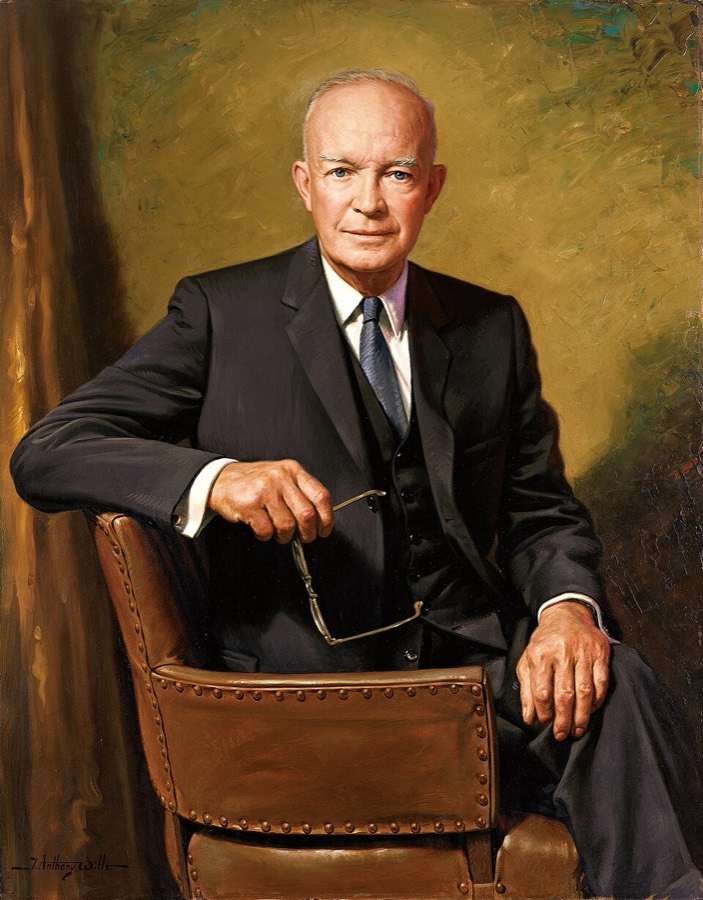
Dwight D. Eisenhower, official portrait · James Anthony Wills · public domain
Where does the Eisenhower matrix fail?
Urgent and important are judgment calls and easy to mis-rate — almost everything can feel important. The matrix organises a decision; it doesn’t make it, and over-categorising can itself become busywork.
- The quadrants are a snapshot — tasks migrate as deadlines approach, so yesterday's sort quietly misleads today.
- It treats tasks as independent, but an 'unimportant' task can block an important one, and dependencies ignore quadrant lines.
- The delegate box assumes someone to delegate to; for a solo worker it collapses into do, schedule, or delete.
The counter-model: The Pareto principle — The matrix sorts on two axes; Pareto sharpens it — within 'important', a few tasks carry most of the value.
How do you apply the Eisenhower matrix, step by step?
- List everything currently competing for your attention, without sorting yet.
- For each item ask two questions separately: does it matter, and does it have a real deadline?
- Place items in the four boxes; be stingy with 'important'.
- Do the urgent-important items now and book scheduled time for the important-not-urgent ones.
- Delegate or delete the rest, and re-sort when circumstances change, not daily.
Frequently asked
- What is the Eisenhower matrix?
- A 2×2 prioritisation tool that sorts tasks by urgency and importance into four actions: do, schedule, delegate, or delete.
- Where does the Eisenhower matrix come from?
- It’s based on a principle attributed to US President Dwight Eisenhower — “what is important is seldom urgent and what is urgent is seldom important” — and was popularised by Stephen Covey.
- Which quadrant is most neglected?
- Important-but-not-urgent — planning, prevention, learning — which gets crowded out by urgent trivia unless deliberately scheduled and protected.
Related
Keep reading
Authority bias
Patients follow the obviously wrong instruction because the doctor said so.
See this alongside the other thinking tools of leadership & managing people and productivity.
The books behind better thinking
Affiliate links. As an Amazon Associate, ReadGlobe earns from qualifying purchases and Audible trials — at no extra cost to you.
Listen to any of these free. Start a free Audible trial and get your first audiobook on the house.
Prefer to read? The canonical picks:
- Thinking, Fast and Slow — Daniel Kahneman
- The Art of Thinking Clearly — Rolf Dobelli
- The Great Mental Models, Volume 1 — Shane Parrish
- Poor Charlie’s Almanack — Charlie Munger
- Super Thinking — Gabriel Weinberg & Lauren McCann
- Seeking Wisdom — Peter Bevelin
Cite this page
ReadGlobe. (2026). The Eisenhower matrix. https://readglobe.com/model/eisenhower-matrix/
"The Eisenhower matrix." ReadGlobe, 30 June 2026, readglobe.com/model/eisenhower-matrix/.
Primary source: Wikipedia
Editorial synthesis © ReadGlobe 2026, drawing on the mental-models tradition (Charlie Munger, Farnam Street) and the primary sources for each model. · Last reviewed 2026-06-30.