The Dunning–Kruger effect
The Dunning–Kruger effect is the finding that people with the least skill in an area tend to overrate their ability most — because the knowledge needed to do a task well is the same knowledge needed to judge how well you’re doing it. Competence and the ability to see your own incompetence arrive together.
- 1 min read
- 5 linked ideas
How does the Dunning–Kruger effect work?
Skill and self-assessment draw on the same understanding. A beginner lacks not only the skill but the yardstick to measure it, so errors go unseen and confidence stays high. As real competence grows, people begin to see the gaps — often becoming less sure — before confidence recovers with genuine expertise.
The knowledge needed to do a task well is the same knowledge needed to judge how well you're doing.
How do you use the Dunning–Kruger effect?
- Reading your own confidence with suspicion in areas you’ve only just entered.
- Weighing loud certainty against a demonstrated track record, not the other way round.
- Designing feedback so beginners get the yardstick they can’t yet supply themselves.
What does the Dunning–Kruger effect look like in practice?
In the original studies, people scoring in the bottom quarter on grammar and logic estimated themselves near the 60th percentile. They weren’t lying — they simply couldn’t recognise their own mistakes, because recognising them required the very skill they lacked.
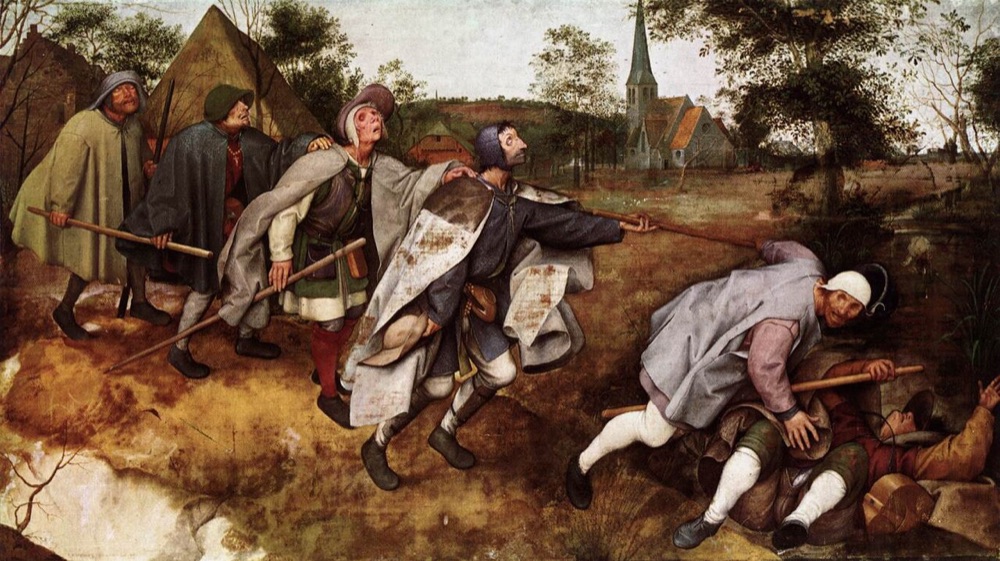
Each blind man confidently follows a guide as sightless as himself and never perceives his own incapacity until he is already falling — Dunning–Kruger made literal, where the very deficiency that dooms them is the one they cannot see.
Pieter Bruegel the Elder, The Parable of the Blind (1568) · Public domain
Where does the Dunning–Kruger effect fail?
It’s widely flattened into “dumb people think they’re smart.” The real effect is smaller and subtler — everyone mis-estimates, strong performers often underrate themselves, and part of the classic curve is a statistical artefact. Use it on yourself, not as an insult for others.
- The classic studies measure self-estimates on narrow quiz tasks; extending the curve to complex real-world skill is an inference, not a finding.
- It offers no way to locate yourself on the curve — it predicts your self-assessment is unreliable, including your assessment of this.
- Effect sizes differ across cultures and tasks, so the pattern is a tendency to test for, not a universal law.
The counter-model: Circle of competence — Dunning–Kruger says you can't see your own incompetence; the circle of competence is the working practice of mapping and respecting its edge.
How do you apply the Dunning–Kruger effect, step by step?
- Before acting on a confident judgment in a new domain, rate your experience there in hours, not feelings.
- Compare your self-rating against an objective check — a test, a track record, a practitioner's review.
- Ask someone skilled in the domain what beginners typically miss.
- Set your caution level from the evidence, not the confidence.
The deeper point
Its most useful reading is inward, not outward: the effect predicts that your blind spots feel exactly like solid ground, so the fields where you feel most effortlessly confident are the first ones to double-check. Expertise often arrives disguised as doubt.
Frequently asked
- What is the Dunning–Kruger effect?
- The tendency of people with low skill in an area to overestimate that skill, because the ability to judge competence requires the same competence they lack.
- Who discovered it?
- Psychologists David Dunning and Justin Kruger, in a 1999 study at Cornell University.
- Does it mean confident people are incompetent?
- No — it’s a subtle statistical tendency, not a rule. The useful lesson is to double-check your own effortless confidence, especially in things you’ve only just learned.
Related
Keep reading
Eternal Recurrence
Every detail of your life, repeated forever — could you say yes to that?
The books behind better thinking
Affiliate links. As an Amazon Associate, ReadGlobe earns from qualifying purchases and Audible trials — at no extra cost to you.
Listen to any of these free. Start a free Audible trial and get your first audiobook on the house.
Prefer to read? The canonical picks:
- Thinking, Fast and Slow — Daniel Kahneman
- The Art of Thinking Clearly — Rolf Dobelli
- The Great Mental Models, Volume 1 — Shane Parrish
- Poor Charlie’s Almanack — Charlie Munger
- Super Thinking — Gabriel Weinberg & Lauren McCann
- Seeking Wisdom — Peter Bevelin
Cite this page
ReadGlobe. (2026). The Dunning–Kruger effect. https://readglobe.com/model/dunning-kruger-effect/
"The Dunning–Kruger effect." ReadGlobe, 1 July 2026, readglobe.com/model/dunning-kruger-effect/.
Primary source: Wikipedia
Editorial synthesis © ReadGlobe 2026, drawing on the mental-models tradition (Charlie Munger, Farnam Street) and the primary sources for each model. · Last reviewed 2026-07-01.