The map is not the territory
“The map is not the territory” means any model, description, or belief is a simplified representation of reality — never reality itself. Maps are useful precisely because they leave things out, but mistaking the map for the terrain leads you astray.
✦ Foundational — cross-referenced 35× across this reference (27 related ideas · 2 comparisons · 4 hubs · 1 book) · The State of Thinking 2026 →
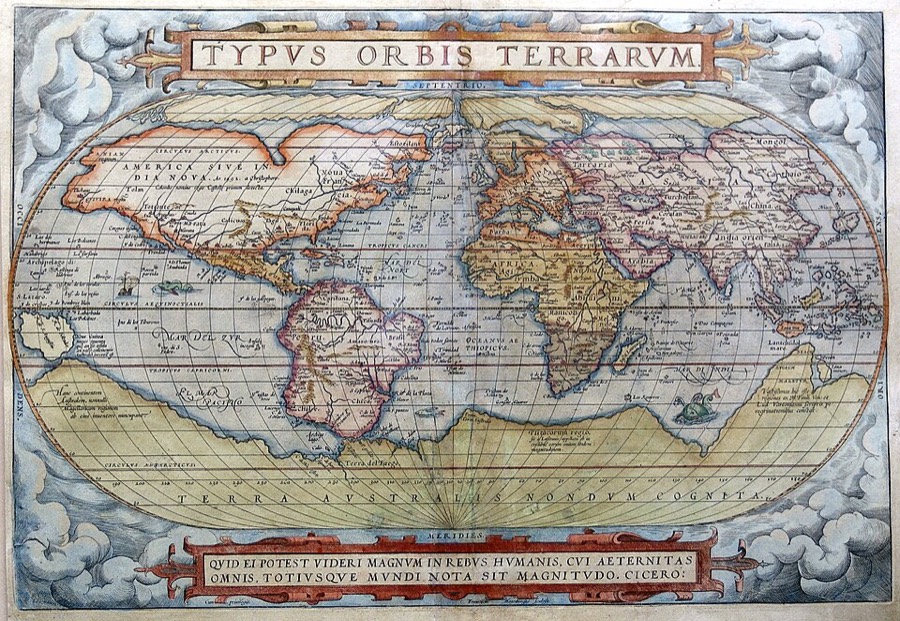
Abraham Ortelius, “Typus Orbis Terrarum” (1570) · public domain
The map is not the territory: how does it work?
Every model omits detail to be usable. Trouble starts when we forget the omission and treat the abstraction — a metric, a stereotype, a plan — as the full reality it merely stands for.
The most dangerous maps are the useful ones: the better a model works, the more we forget what it hides.
The map is not the territory: how do you use it?
- Treat metrics and models as useful approximations, not truth — always ask what they leave out.
- When a plan meets messy reality, update the map; don’t force the terrain to fit it.
- Distrust any single representation; consult several maps of the same thing.
The map is not the territory: what does it look like in practice?
A company optimising purely for its headline KPI (the map) can wreck the actual goal (the territory) — maximising “calls handled per hour” while customer satisfaction quietly collapses. The metric was never the thing itself.
The map is not the territory: where does it fail?
Knowing maps are imperfect can tip into dismissing all models (“nothing is really knowable”). The point is to use maps while remembering their limits — not to abandon them.
- The principle tells you every model is wrong but not by how much or where — it offers no method for locating a map's specific distortions.
- Some maps alter the territory they describe: prices, polls, and forecasts change behavior, so the map-territory boundary itself moves in social systems.
- Invoked selectively, it becomes a universal escape hatch — any inconvenient data can be waved off as 'just a map' while convenient maps go unquestioned.
The counter-model: Bayesian thinking — Map-is-not-the-territory warns that models are imperfect; Bayesian thinking supplies the corrective procedure — keep the map, and update it in proportion to each collision with the terrain.
The map is not the territory: how do you apply it, step by step?
- Identify the model, metric, or report you are about to act on.
- Ask what it deliberately leaves out and who made those choices.
- Find one point of direct contact with reality — a site visit, a raw transcript, a customer call.
- Note where the direct observation contradicts the model.
- Act on the model only where it survived contact; flag the contradictions for revision.
The deeper point
The most dangerous maps are the useful ones. The better a model works, the more we trust it — and the more we forget what it leaves out. Precision quietly breeds overconfidence; the failures come from the gaps the map was never drawn to show.
Frequently asked
- What does “the map is not the territory” mean?
- That our models and descriptions of reality are simplifications, not reality itself — useful, but never complete, and dangerous when mistaken for the real thing.
- Who said the map is not the territory?
- The phrase comes from Alfred Korzybski, founder of general semantics, who used it to warn against confusing words and models with the reality they represent.
- How do you apply this mental model?
- Treat metrics, plans, and stereotypes as approximations — ask what they omit, update them when reality differs, and avoid trusting any single map.
Compared side by side
Related
Keep reading
Illusory correlation
It always rains right after you wash the car — because the dry days never make it into memory.
See this alongside the other thinking tools of product management, learning, writing clearly and software engineers.
Go deeper
Affiliate links. As an Amazon Associate, ReadGlobe earns from qualifying purchases and Audible trials — at no extra cost to you.
The book behind this idea: The Great Mental Models, Volume 1 by Shane Parrish. Hear the whole thing free — start an Audible trial and your first audiobook is on the house.
Read the full summary of The Great Mental Models, Volume 1 →
More canonical picks:
- Thinking, Fast and Slow — Daniel Kahneman
- The Art of Thinking Clearly — Rolf Dobelli
- Poor Charlie’s Almanack — Charlie Munger
- Super Thinking — Gabriel Weinberg & Lauren McCann
- Seeking Wisdom — Peter Bevelin
Cite this page
ReadGlobe. (2026). The map is not the territory. https://readglobe.com/model/map-is-not-the-territory/
"The map is not the territory." ReadGlobe, 29 May 2026, readglobe.com/model/map-is-not-the-territory/.
Primary source: Wikipedia
Editorial synthesis © ReadGlobe 2026, drawing on the mental-models tradition (Charlie Munger, Farnam Street) and the primary sources for each model. · Last reviewed 2026-05-29.