Survivorship bias
Survivorship bias is focusing on the people or things that made it through a selection process while overlooking those that didn’t — usually because the failures are invisible. It makes success look more achievable, and its causes clearer, than they really are.
✦ Widely referenced — cross-referenced 17× across this reference (7 related ideas · 1 comparisons · 5 hubs · 4 books) · The State of Thinking 2026 →
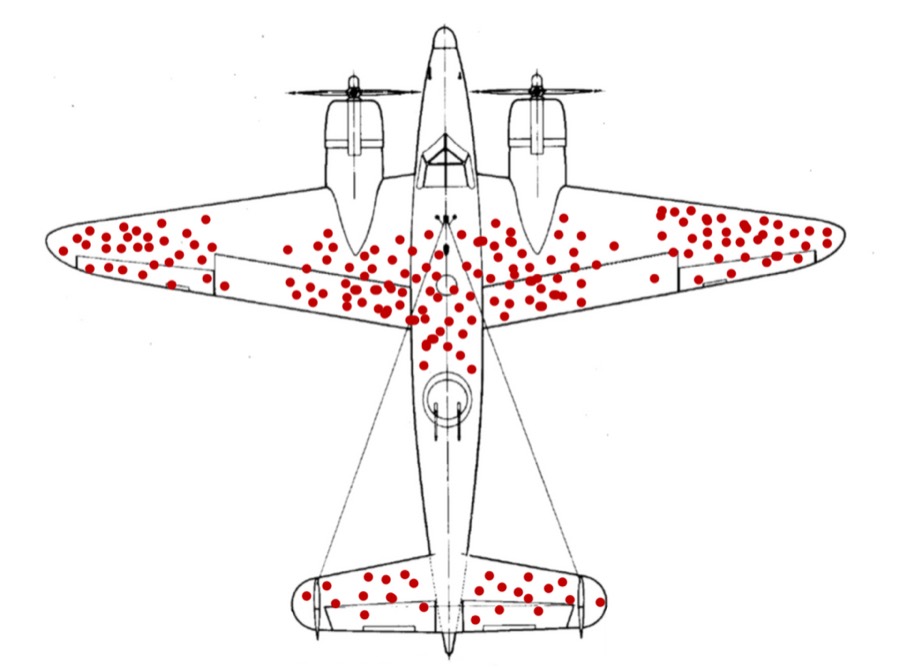
Survivorship bias diagram · McGeddon · CC BY-SA 4.0
Why does survivorship bias happen?
Survivors are visible and vocal; failures drop out of the dataset and out of view. Any analysis that studies only what remained is silently conditioning on success, so its conclusions are drawn from a biased sample.
The most dangerous data is the data that isn't there — you have to go looking for the silence.
What does survivorship bias look like in real life?
- Studying only successful founders for “the habits of success,” ignoring identical habits in those who failed.
- Abraham Wald’s WWII insight: reinforce planes where returning survivors were NOT hit — the planes hit there never came back.
- “They built things better in the old days” — the flimsy old buildings are simply gone.
How do you counter survivorship bias?
- Ask: “Where are the failures, and what would they show me?”
- Seek the full base rate, not just the winners’ stories.
- Treat any success-only sample as evidence about survival, not about cause.
The deeper point
The most dangerous data is the data that isn’t there. This isn’t a reasoning error you can think your way out of — it’s a sampling error baked into what you’re allowed to see. You have to go looking for the silence.
Frequently asked
- What is a classic example of survivorship bias?
- Abraham Wald advising the WWII military to armor the parts of returning bombers that had no bullet holes — because planes hit in those spots never returned to be counted.
- Why is survivorship bias dangerous in business advice?
- It studies only winners, so it mistakes traits common to survivors for causes of success — ignoring that failures often had the same traits. The lesson is unfalsifiable.
- How do you avoid survivorship bias?
- Deliberately look for the invisible failures, ask for the base rate of attempts, and treat success-only datasets as conditioned on survival rather than proving causation.
Compared side by side
Keep reading
Primacy effect
Whatever comes first sets the frame everything after is judged against.
See this alongside the other thinking tools of building a startup, product management, persuasion & marketing and hiring.
This bias distorts product decisions.
Go deeper
Affiliate links. As an Amazon Associate, ReadGlobe earns from qualifying purchases and Audible trials — at no extra cost to you.
The book behind this idea: Fooled by Randomness by Nassim Nicholas Taleb. Hear the whole thing free — start an Audible trial and your first audiobook is on the house.
Read the full summary of Fooled by Randomness →
More canonical picks:
- Thinking, Fast and Slow — Daniel Kahneman
- The Art of Thinking Clearly — Rolf Dobelli
- The Great Mental Models, Volume 1 — Shane Parrish
- Poor Charlie’s Almanack — Charlie Munger
- Super Thinking — Gabriel Weinberg & Lauren McCann
- Seeking Wisdom — Peter Bevelin
Cite this page
ReadGlobe. (2026). Survivorship bias. https://readglobe.com/bias/survivorship-bias/
"Survivorship bias." ReadGlobe, 29 May 2026, readglobe.com/bias/survivorship-bias/.
Primary source: Wikipedia
Editorial synthesis © ReadGlobe 2026, drawing on Kahneman’s Thinking, Fast and Slow, the Tversky–Kahneman research program, and the primary cognitive-science literature. · Last reviewed 2026-05-29.