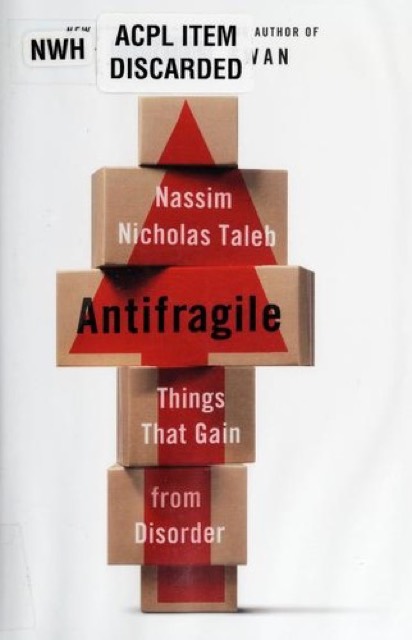
Antifragile
by Nassim Nicholas Taleb
Antifragile things gain from disorder: unlike the merely robust, which resists shocks, the antifragile improves when stressed, so the practical task is to build systems that profit from volatility rather than break under it.
What does Antifragile teach?
Taleb argues that the opposite of fragile is not robust but antifragile — a category he claims language never named. Fragile things (a teacup, an over-optimized supply chain, a debt-laden bank) suffer disproportionately from shocks; antifragile things (evolution, muscle, a well-structured trading position) need volatility to strengthen. His central prescription is via negativa: you improve a system faster by removing what harms it than by adding what supposedly helps, because harm compounds and few interventions truly work. He ties this to the Lindy effect — for ideas and technologies, the longer something has survived, the longer its remaining life expectancy — and to optionality, the practice of holding many small bets with capped downside and open-ended upside. Read it for a framework that treats uncertainty as a resource, and for a sustained attack on forecasting, fragility-hiding, and expertise without accountability.
Which ideas does Antifragile explain?
Read the idea in two minutes, then read the book behind it.
Read or listen to Antifragile
Hear the whole book free: start an Audible trial and your first audiobook — this one, if you like — is on the house.
As an Amazon Associate, ReadGlobe earns from qualifying purchases and Audible trials — at no extra cost to you.