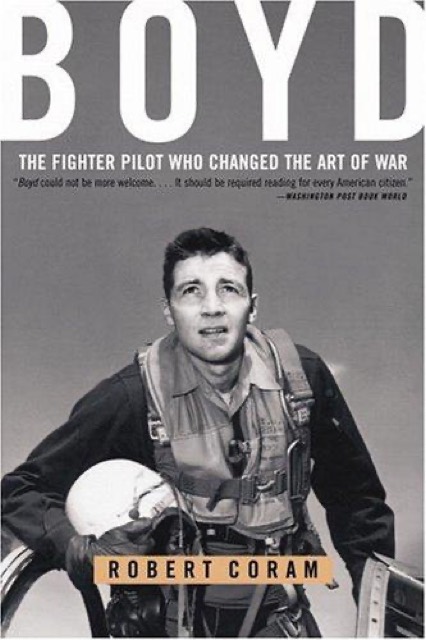
Boyd: The Fighter Pilot Who Changed the Art of War
by Robert Coram
John Boyd argued that victory belongs not to the stronger force but to the faster mind — the side that observes, orients, decides, and acts through its "OODA loop" quicker than the enemy can react, collapsing his ability to cope.
What does Boyd: The Fighter Pilot Who Changed the Art of War teach?
Robert Coram's biography traces how a maverick U.S. Air Force fighter pilot became one of the twentieth century's most consequential military theorists. Boyd's core insight, drawn from air combat, generalizes to any conflict: the decisive variable is tempo. Whoever cycles faster through observation, orientation, decision, and action forces the opponent into confusion and paralysis. This became the OODA loop, and it underwrote maneuver warfare — winning by dislocation and speed rather than attrition and firepower. Boyd's ideas reshaped Marine Corps doctrine and influenced the 1991 Gulf War's ground campaign, yet he died with almost no official recognition, having refused promotions and made enemies of the Pentagon establishment. Read it for the theory of adaptation under uncertainty, and for a portrait of intellectual integrity carried to a ruinous, admirable extreme.
Which ideas does Boyd: The Fighter Pilot Who Changed the Art of War explain?
Read the idea in two minutes, then read the book behind it.
Read or listen to Boyd: The Fighter Pilot Who Changed the Art of War
Hear the whole book free: start an Audible trial and your first audiobook — this one, if you like — is on the house.
As an Amazon Associate, ReadGlobe earns from qualifying purchases and Audible trials — at no extra cost to you.