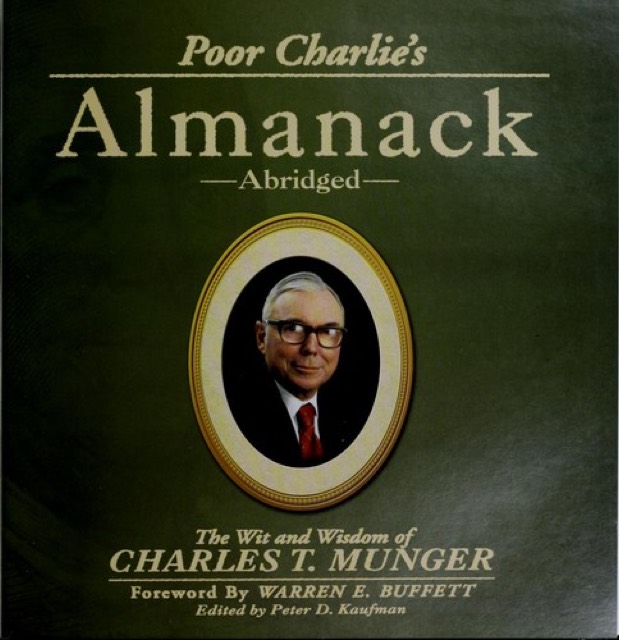
Poor Charlie's Almanack
by Charlie Munger
Better thinking comes from assembling a "latticework" of models drawn from many disciplines, then reasoning backward: to solve a problem, first ask how you would guarantee failure, and avoid that.
What does Poor Charlie's Almanack teach?
Munger's argument, collected from his speeches and the "Psychology of Human Misjudgment" essay, is that most errors come from a narrow toolkit. A person who knows only finance, or only law, forces every problem into one frame. The remedy is worldly wisdom: borrow the big ideas from physics, biology, economics, and psychology, and hold them as a latticework so each checks the others. Two habits follow. Inversion—solving forward and backward, asking what would ruin the outcome—exposes risks that direct reasoning hides. Staying inside a "circle of competence," and knowing its edge, prevents confident mistakes in unfamiliar territory. Running through it all is incentives: Munger insists that misjudging what motivates people is the deepest, most common failure. The book suits investors, managers, and anyone who wants durable judgment rather than clever tactics.
Which ideas does Poor Charlie's Almanack explain?
Read the idea in two minutes, then read the book behind it.
Read or listen to Poor Charlie's Almanack
Hear the whole book free: start an Audible trial and your first audiobook — this one, if you like — is on the house.
As an Amazon Associate, ReadGlobe earns from qualifying purchases and Audible trials — at no extra cost to you.