Game theory
Game theory is the study of strategic decisions, where your best move depends on what others choose and theirs depends on you. It models situations as "games" with players, choices, and payoffs — revealing why rational individuals sometimes reach bad collective outcomes.
✦ Widely referenced — cross-referenced 12× across this reference (8 related ideas · 1 hubs · 2 books) · The State of Thinking 2026 →
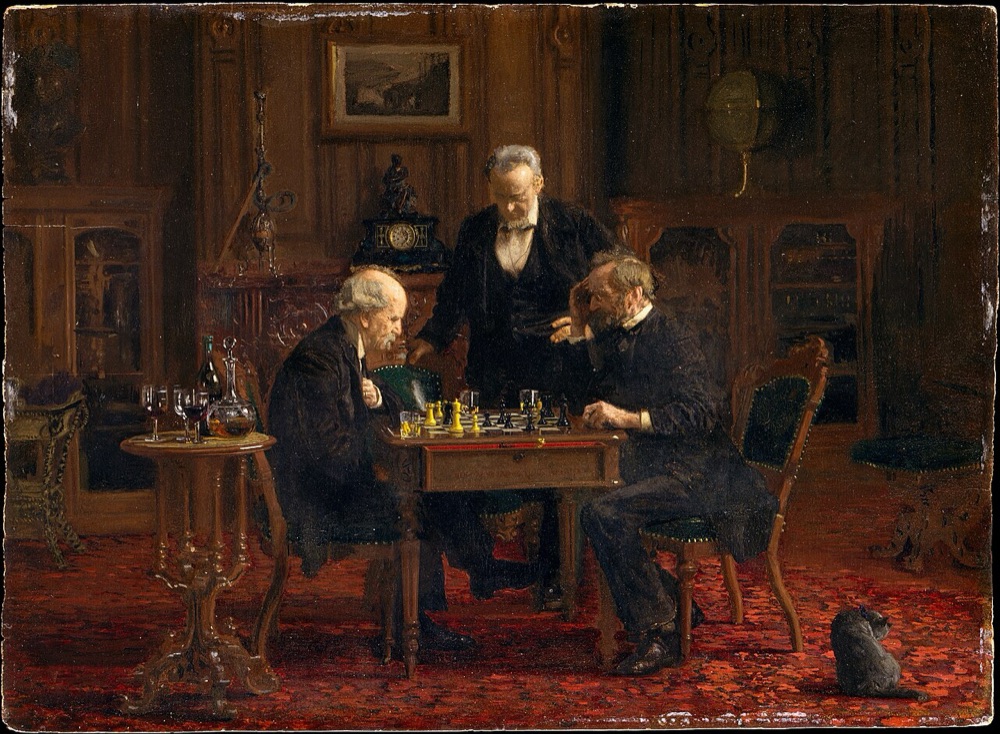
Two minds bent over a chessboard, each next move determined by the opponent's reply — the archetypal image of strategic interdependence, where the best choice depends entirely on anticipating the other player.
Thomas Eakins, The Chess Players (1876) · CC0 (The Met)
How does game theory work?
Map the players, their possible choices, and the payoff each combination gives everyone. Then reason about how others will act in their own interest, and choose your move anticipating theirs — looking for equilibria where no one can improve by changing alone.
Many disasters require no villains — when payoffs are structured wrong, reasonable people produce ruin together.
How do you use game theory?
- Anticipating competitors’, negotiators’, or rivals’ responses to your moves.
- Understanding why arms races, price wars, and overfishing happen despite hurting everyone.
- Designing rules and incentives so that self-interested players reach good outcomes.
What does game theory look like in practice?
Two rival shops both want to cut prices to win customers. If both hold, both profit; if one cuts, it grabs the market; fearing that, both cut — and both end up worse off. Individually rational choices produce a collectively bad result.
Where does game theory fail?
Classic game theory assumes rational, self-interested players with known payoffs — real people are emotional, cooperative, repeat the game, and misread the stakes. The models illuminate the logic but rarely capture the full mess of human behaviour.
- A payoff matrix requires enumerating all players and moves; in open-ended situations the real game is usually mis-specified before analysis begins.
- Many games have multiple equilibria, so the theory often predicts a set of possible outcomes without saying which will occur.
- Modeling others as opponents can be self-fulfilling: treating a relationship as a game changes how the other side plays it.
The counter-model: Hanlon’s razor — Game theory assumes the other side is playing strategically; Hanlon's razor reminds you many moves are mistakes, not calculated plays.
How do you apply game theory, step by step?
- Name the players and what each can actually choose.
- Write down each player's payoff for every combination of choices, including yours.
- Find the other side's best response to each of your possible moves.
- Check whether the game repeats — repetition and reputation change what is rational.
- Choose the move that holds up against their best response, not their worst.
The deeper point
Its most important lesson is uncomfortable: many disasters require no villains. When payoffs are structured a certain way, perfectly reasonable people produce ruin together — so the fix is usually the rules of the game, not the morality of the players.
Frequently asked
- What is game theory?
- It’s the study of strategic decision-making where each player’s best choice depends on what the others do. It models interactions as "games" with players, options, and payoffs to predict and explain behaviour.
- What is a simple example of game theory?
- The prisoner’s dilemma: two people are each better off betraying the other, so both betray and both end up worse than if they’d cooperated — individual rationality producing a bad joint outcome.
- Why is game theory useful?
- It reveals why rational individuals sometimes reach poor collective results — price wars, arms races, overfishing — and helps design rules and incentives so self-interested players are steered toward better outcomes.
Related
Keep reading
Hindsight bias
Once the outcome lands, memory quietly edits what you believed beforehand.
See this alongside the other thinking tools of negotiation.
Go deeper
Affiliate links. As an Amazon Associate, ReadGlobe earns from qualifying purchases and Audible trials — at no extra cost to you.
The book behind this idea: The Evolution of Cooperation by Robert Axelrod. Hear the whole thing free — start an Audible trial and your first audiobook is on the house.
Read the full summary of The Evolution of Cooperation →
More canonical picks:
- Thinking, Fast and Slow — Daniel Kahneman
- The Art of Thinking Clearly — Rolf Dobelli
- The Great Mental Models, Volume 1 — Shane Parrish
- Poor Charlie’s Almanack — Charlie Munger
- Super Thinking — Gabriel Weinberg & Lauren McCann
- Seeking Wisdom — Peter Bevelin
Cite this page
ReadGlobe. (2026). Game theory. https://readglobe.com/model/game-theory/
"Game theory." ReadGlobe, 29 May 2026, readglobe.com/model/game-theory/.
Primary source: Wikipedia
Editorial synthesis © ReadGlobe 2026, drawing on the mental-models tradition (Charlie Munger, Farnam Street) and the primary sources for each model. · Last reviewed 2026-05-29.