Red Queen effect
The Red Queen effect is the need to keep improving just to maintain your position, because competitors and the environment are improving too. Like the Red Queen in Through the Looking-Glass, you must run as fast as you can simply to stay in the same place.
- 1 min read
- 2 books teach this
- 3 linked ideas
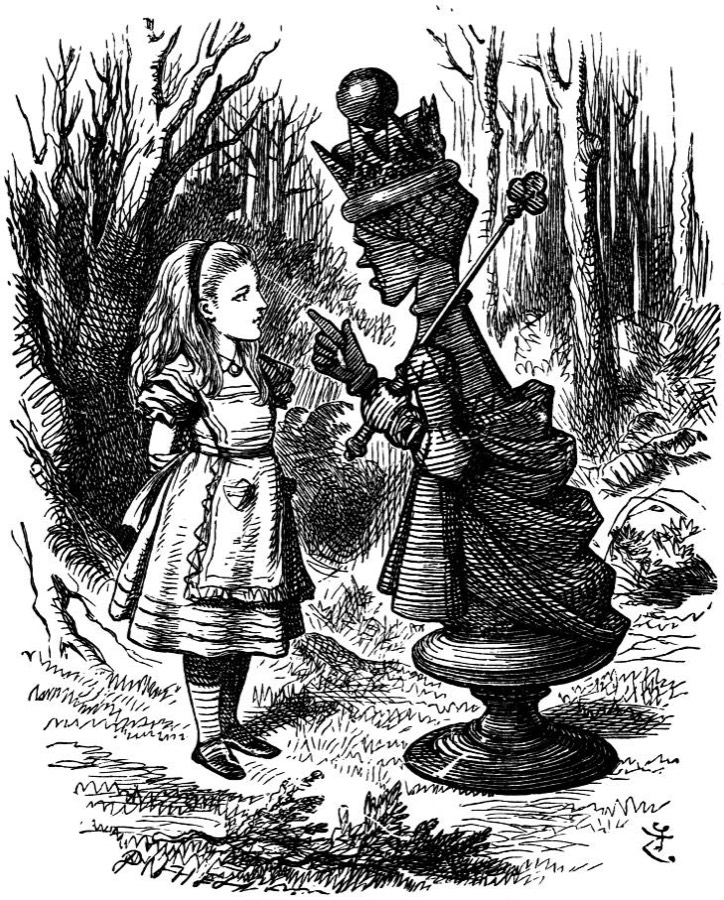
John Tenniel, “Through the Looking-Glass” (1871) · public domain
How does the Red Queen effect work?
In any competitive or co-evolving system, treat standing still as falling behind. Progress is relative: an improvement that doesn’t outpace rivals’ improvements yields no lasting advantage. Expect that every edge erodes as others adapt to it.
When everyone improves, improvement becomes the price of staying in the game, not a way to win it.
How do you use the Red Queen effect?
- Explaining why industries, species, and arms races run constant innovation just to survive.
- Recognising that a competitive advantage decays as rivals copy it.
- Knowing when you’re in a Red Queen race (run to stay even) versus a winnable game.
What does the Red Queen effect look like in practice?
Predator and prey co-evolve: faster cheetahs select for faster gazelles, which select for faster cheetahs. Neither gains lasting ground — both invest enormous energy in speed just to keep the same balance. The race never ends, and standing still means extinction.
Where does the Red Queen effect fail?
Not every competition is a Red Queen race — sometimes you can change the game, find an uncontested niche, or build a durable moat that ends the running. Assuming you must always race harder can trap you in exhausting, unwinnable competition.
- Relative position is hard to measure mid-race; you can run hard against the wrong rivals while the real threat comes from outside the race.
- The metaphor treats all improvement as defensive, obscuring that some gains compound into genuine, lasting separation from the field.
- It offers no stopping rule — taken alone, it justifies unlimited effort on any competitive dimension, useful or not.
The counter-model: Economic moat — The Red Queen says you must keep running to stand still; a moat is the structural advantage that lets you stop.
How do you apply the Red Queen effect, step by step?
- Identify who you are actually racing and on which dimension customers or survival is judged.
- Estimate how fast rivals are improving on that dimension.
- Match or exceed that pace on the dimensions that matter; deliberately drop the ones that do not.
- Periodically ask whether a moat, niche, or different game would end the race entirely.
The deeper point
It explains why so much effort produces no advantage: when everyone improves, improvement becomes the price of staying in the game, not a way to win it. The real escape is rarely running faster — it’s finding a race where you’re not just keeping pace.
Frequently asked
- What is the Red Queen effect?
- It’s the need to keep improving just to hold your position, because competitors and the environment keep improving too. The name comes from the Red Queen’s line in Through the Looking-Glass: you must run to stay in the same place.
- What is an example of the Red Queen effect?
- Predator-prey co-evolution: cheetahs and gazelles both get faster over generations, but neither gains lasting advantage — they run an endless race just to maintain the same balance.
- How do you escape a Red Queen race?
- By changing the game rather than running harder: find an uncontested niche, build a durable moat competitors can’t copy, or compete on a dimension where you can win lastingly instead of matching rivals step for step.
Related
Keep reading
Base-rate neglect
One positive from a 99%-accurate test — and you're still probably fine.
See this alongside the other thinking tools of career growth.
Go deeper
Affiliate links. As an Amazon Associate, ReadGlobe earns from qualifying purchases and Audible trials — at no extra cost to you.
The book behind this idea: The Red Queen by Matt Ridley. Hear the whole thing free — start an Audible trial and your first audiobook is on the house.
Read the full summary of The Red Queen →
More canonical picks:
- Thinking, Fast and Slow — Daniel Kahneman
- The Art of Thinking Clearly — Rolf Dobelli
- The Great Mental Models, Volume 1 — Shane Parrish
- Poor Charlie’s Almanack — Charlie Munger
- Super Thinking — Gabriel Weinberg & Lauren McCann
- Seeking Wisdom — Peter Bevelin
Cite this page
ReadGlobe. (2026). Red Queen effect. https://readglobe.com/model/red-queen-effect/
"Red Queen effect." ReadGlobe, 29 May 2026, readglobe.com/model/red-queen-effect/.
Primary source: Wikipedia
Editorial synthesis © ReadGlobe 2026, drawing on the mental-models tradition (Charlie Munger, Farnam Street) and the primary sources for each model. · Last reviewed 2026-05-29.