Barnum effect
The Barnum effect is the tendency to accept vague, general personality descriptions as uniquely accurate about yourself. Statements broad enough to fit almost anyone feel personally revealing — the mechanism behind horoscopes, fortune-telling, and many personality tests.
- 1 min read
- 6 linked ideas
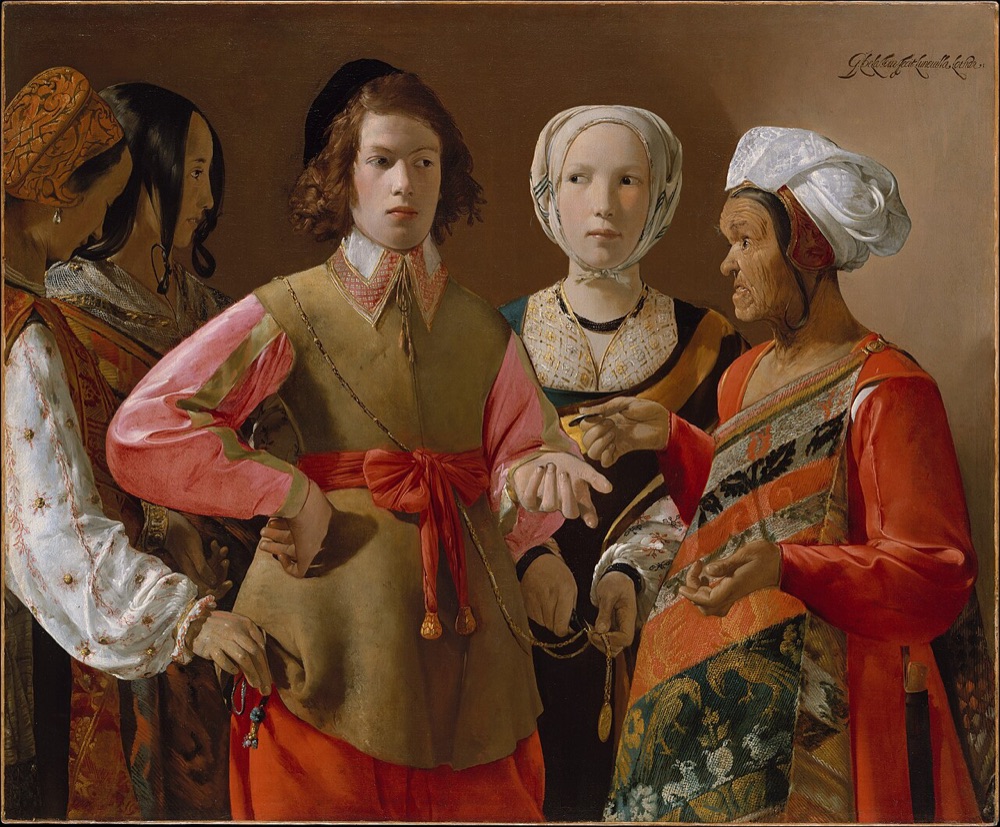
La Tour's fortune-teller delivers a rapt, flattering reading while her accomplices lift the young man's purse and gold chain — the con of the personalized prophecy, believed precisely because it feels made just for him, which is the Barnum effect exactly.
Georges de La Tour, The Fortune Teller (c. 1630s) · CC0 (The Metropolitan Museum of Art)
Why does the Barnum effect happen?
We read general statements through the lens of our own life, supplying the specifics that make them fit. A flattering or authoritative source lowers our guard, and confirmation bias makes us notice the parts that match while ignoring the parts that don’t. Subjective validation does the rest.
The reader does the work: you fill the blank with your own life, then credit the source for the insight you supplied.
What does the Barnum effect look like in real life?
- A horoscope saying "you have a great need for others to like you, yet tend to be self-critical" feeling spot-on.
- Personality quizzes whose results feel uncannily accurate but describe nearly everyone.
- A cold reader or "psychic" landing hits with statements true of most people.
How do you counter the Barnum effect?
- Ask: "Would this description fit most other people too?" If yes, it tells you nothing specific.
- Notice flattering or authoritative framing — it lowers your scepticism.
- Demand falsifiable specifics, not vague generalities that can’t be wrong.
The deeper point
It works because the reader does the work: the statement is a blank, and you unconsciously fill it with your own life, then credit the source with the insight you supplied. The "accuracy" you feel is a mirror, not a window.
Frequently asked
- What is the Barnum effect?
- It is accepting vague, broadly applicable personality descriptions as uniquely true of you. Statements that fit almost anyone feel personally accurate — the engine behind horoscopes, fortune-telling, and many personality tests.
- Why is it called the Barnum or Forer effect?
- It is named after showman P.T. Barnum ("a little something for everybody") and psychologist Bertram Forer, who in 1948 gave students an identical vague "personality profile" they each rated as highly accurate about themselves.
- How do you avoid the Barnum effect?
- Test whether a description would fit most people too — if so, it says nothing specific about you. Be extra sceptical of flattering, authoritative wording, and demand falsifiable specifics over vague generalities.
Keep reading
Occam’s razor
Each extra assumption is another way to be wrong; check the typo before the coordinated attack.
The books behind better thinking
Affiliate links. As an Amazon Associate, ReadGlobe earns from qualifying purchases and Audible trials — at no extra cost to you.
Listen to any of these free. Start a free Audible trial and get your first audiobook on the house.
Prefer to read? The canonical picks:
- Thinking, Fast and Slow — Daniel Kahneman
- The Art of Thinking Clearly — Rolf Dobelli
- The Great Mental Models, Volume 1 — Shane Parrish
- Poor Charlie’s Almanack — Charlie Munger
- Super Thinking — Gabriel Weinberg & Lauren McCann
- Seeking Wisdom — Peter Bevelin
Cite this page
ReadGlobe. (2026). Barnum effect. https://readglobe.com/bias/barnum-effect/
"Barnum effect." ReadGlobe, 29 May 2026, readglobe.com/bias/barnum-effect/.
Primary source: Wikipedia
Editorial synthesis © ReadGlobe 2026, drawing on Kahneman’s Thinking, Fast and Slow, the Tversky–Kahneman research program, and the primary cognitive-science literature. · Last reviewed 2026-05-29.