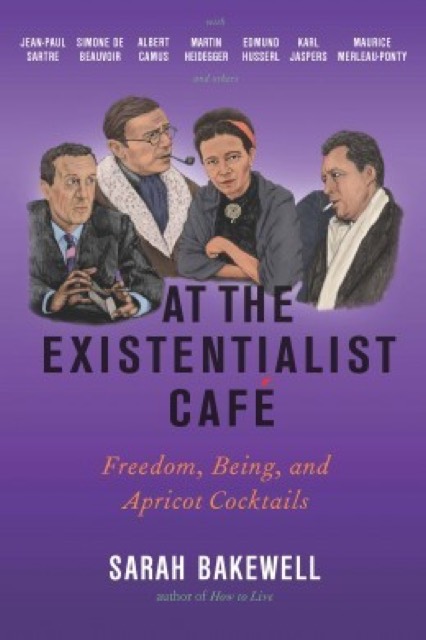
At the Existentialist Café
by Sarah Bakewell
Existentialism was a lived philosophy of freedom, hammered out in Paris cafés by thinkers who insisted that existence precedes essence — that we are what we make of ourselves, and are condemned to choose.
What does At the Existentialist Café teach?
Bakewell braids biography and ideas to trace how a fringe German method — Husserl's phenomenology, the disciplined study of experience as it appears — passed to Heidegger and then ignited in the hands of Sartre, Beauvoir, Camus, and Merleau-Ponty. Her argument is that existentialism mattered because it took ordinary life seriously: the apricot cocktail, the waiter playing at being a waiter, the vertigo of being free. She shows freedom as the movement's burden, not its slogan — we cannot escape choosing, and bad faith is the lie we tell to dodge that fact. She does not flinch from Heidegger's Nazism or Sartre's political blind spots. Read it for a warm, rigorous group portrait of philosophy done as if it were about how to actually live.
Which ideas does At the Existentialist Café explain?
Read the idea in two minutes, then read the book behind it.
Read or listen to At the Existentialist Café
Hear the whole book free: start an Audible trial and your first audiobook — this one, if you like — is on the house.
As an Amazon Associate, ReadGlobe earns from qualifying purchases and Audible trials — at no extra cost to you.