Existentialism
A philosophy holding that existence precedes essence — we are not born with a fixed purpose but must create meaning through our choices.
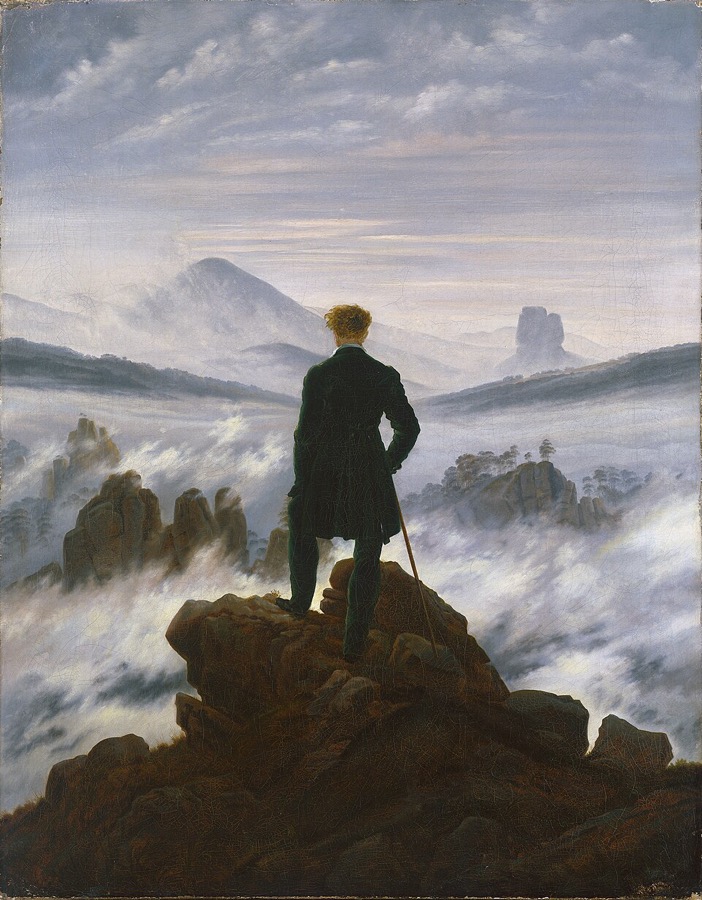
Caspar David Friedrich, “Wanderer above the Sea of Fog” (c. 1818) · public domain
Existentialism centres on the individual confronting a world without given meaning, and the freedom — and anxiety — that follows. Anticipated by Kierkegaard and Nietzsche and developed by Sartre, Camus, and de Beauvoir, it insists that we are "condemned to be free": responsible for who we become. Themes include authenticity, the absurd, dread, and the refusal of bad-faith excuses. Where Stoicism seeks alignment with a rational nature, existentialism stresses radical freedom and self-creation.
Existence precedes essence: we are condemned to be free, responsible for who we become.
Core tenets
- Existence precedes essence — you are born with no fixed purpose and create your essence through what you choose and do.
- Radical freedom — we are "condemned to be free"; even refusing to choose is a choice you own.
- Authenticity — living by freely-chosen values rather than inherited roles and expectations.
- The absurd — the clash between our hunger for meaning and a universe that supplies none in itself.
- Anxiety (angst) is not a malfunction but the felt experience of freedom — the dizziness of possibility.
In practice today
Lived existentialism means owning your choices without alibi — no blaming nature, society, or circumstance for who you become. It asks you to face the absurd honestly (Camus) and revolt by creating meaning anyway, and to catch "bad faith": the small self-deceptions by which we pretend we had no choice.
Core ideas
- Eternal Recurrence — Nietzsche's thought-experiment: if you had to live your life over and over, identically, forever — could you affirm it?
Contrasts with
Compare Existentialism
Frequently asked
- What does "existence precedes essence" mean?
- That humans have no predetermined purpose. Unlike a tool built for a function, you exist first and define what you are through your choices — you author your own essence.
- Is existentialism pessimistic?
- Not necessarily. It begins with a meaningless universe and the anxiety of freedom, but most existentialists treat that freedom as the ground of dignity — Camus ends in revolt and affirmation, not despair.
- What is "bad faith"?
- Sartre’s term for self-deception in which we deny our own freedom — pretending our roles, feelings, or circumstances forced our hand, to dodge the responsibility of choosing.
Where to start with Existentialism
The short answer: Start with Sartre’s lecture Existentialism Is a Humanism — one evening, the whole framework. Then Camus’s Myth of Sisyphus and de Beauvoir’s Ethics of Ambiguity. Kierkegaard and Heidegger are the deep sources, read after.
Gentle · start here — no background needed
Existentialism Is a Humanism — Jean-Paul SartreStart here
The famous 1945 public lecture — "existence precedes essence" explained by the man who coined the slogan, in under a hundred pages.
The Myth of Sisyphus — Albert Camus
The absurd, stated plainly: how to live without appeal to cosmic meaning. Camus denied being an existentialist — reading why is half the education.
At the Existentialist Café — Sarah Bakewell
The group biography — Sartre, Beauvoir, Camus, Heidegger, and apricot cocktails. The best map of who argued what, and why it mattered.
Moderate · once the ideas are familiar
The Ethics of Ambiguity — Simone de Beauvoir
The movement’s clearest ethics — what freedom demands once you take it seriously. Many readers find it more rigorous than Sartre’s own attempt.
Fear and Trembling — Søren Kierkegaard
The 19th-century source — Abraham, the leap of faith, and the individual before the universal. Existentialism’s grandfather text.
Deep end · the demanding texts, worth the climb
Being and Nothingness — Jean-Paul Sartre
The 700-page systematic statement — bad faith, the look, radical freedom. Attempt it only after the lecture and Beauvoir; it rewards preparation and punishes cold starts.
Prefer to listen? Most of this list is on Audible — start a free trial and the first one is on the house.
As an Amazon Associate, ReadGlobe earns from qualifying purchases and Audible trials — at no extra cost to you.
What people get wrong about Existentialism
- “Existentialism teaches that life is meaningless, so nothing matters.”
- Actually: It teaches the opposite conclusion from the same premise: no pre-given meaning makes you radically responsible for the meaning you create. Sartre called it the most optimistic of doctrines.
- “Camus was an existentialist.”
- Actually: He explicitly and repeatedly rejected the label, and his 1952 public break with Sartre made the distance permanent. The absurd is not the same move as radical freedom.
- “"Hell is other people" means Sartre hated company.”
- Actually: The line from No Exit is about being trapped in others’ judgments — frozen into the object they see. Sartre himself said it was widely misunderstood and did not mean relationships are hell.
Sartre’s optimism claim and the slogan: Existentialism Is a Humanism (1946). Camus’s rejection of the label: interviews collected in Lyrical and Critical Essays; the 1952 Sartre–Camus rupture followed The Rebel. Sartre’s clarification of "hell is other people": 1965 preface remarks to No Exit.
Keep reading

Survivorship bias
Armour the bombers where the survivors show no holes — those hits never came home.
Cite this page
ReadGlobe. Existentialism. https://readglobe.com/school/existentialism/
"Existentialism." ReadGlobe, readglobe.com/school/existentialism/.
Primary source: Wikipedia
Summary synthesised from the Stanford Encyclopedia of Philosophy and Wikipedia (CC-BY-SA).