Plato
Founder of the Academy who framed the questions Western philosophy still argues about.
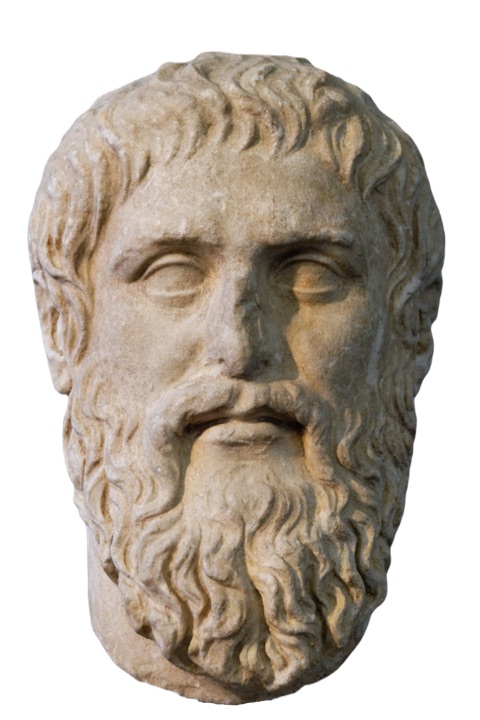
Plato, a student of Socrates and teacher of Aristotle, wrote in dialogues rather than treatises — staging arguments instead of declaring conclusions. His Theory of Forms holds that the things we perceive are imperfect copies of perfect, unchanging ideals: a drawn circle gestures at the Circle, which exists only to thought. From this follows his view that knowledge is recollection and that the philosopher's task is to turn the soul from shadow toward light, dramatised in the Allegory of the Cave. In the Republic he built the first systematic political philosophy, mapping the just city onto the just soul. Founding the Academy around 387 BCE, he created the institutional model of the school of thought itself. Almost every later debate — about reality, justice, beauty, knowledge — begins as a footnote to Plato.
Knowledge is recollection; the philosopher’s task is to turn the soul from shadow toward light.
Why Plato still matters
Plato effectively invented Western philosophy as a written discipline — Whitehead called the whole tradition "a series of footnotes to Plato." He is also the reason we have Socrates at all: almost everything we know of his teacher comes through Plato’s dialogues.
The one big idea
Behind the changing, imperfect world we see lies a realm of perfect, unchanging Forms — and true knowledge is grasping those, not the shadows. The Allegory of the Cave is his unforgettable image for it.
Commonly misunderstood
The Republic is often read as a literal political blueprint (the "philosopher-king" state). Many scholars read it instead as an analogy: the ideal city is a model for the well-ordered soul, not a manifesto for government.
Key ideas
- The Allegory of the Cave — Plato's image of prisoners mistaking shadows on a wall for reality — a picture of how education turns the soul from illusion toward truth.
Famous quotes
- “We can easily forgive a child who is afraid of the dark; the real tragedy of life is when men are afraid of the light.” — Attributed (paraphrase of the Cave)
- “The beginning is the most important part of the work.” — The Republic, Book II
- “There are three classes of men: lovers of wisdom, lovers of honour, and lovers of gain.” — The Republic (paraphrase)
Influenced
Compare Plato
Frequently asked
- What is Plato’s theory of Forms?
- That the truest reality is a realm of perfect, abstract Forms (like Justice or Beauty itself), of which physical things are imperfect copies. Knowledge means apprehending the Forms, not the shifting sensory world.
- What is the Allegory of the Cave about?
- Prisoners mistake shadows on a wall for reality; one escapes, sees the real world, and returns — an image of philosophical education and the difficulty of waking others to deeper truth.
- What is the difference between Plato and Aristotle?
- Plato located true reality in transcendent Forms beyond the physical world; his student Aristotle brought it back down, locating essence within things themselves and trusting empirical observation.
Where to start with Plato
The short answer: Start with the trial dialogues — Euthyphro, Apology, Crito — where Socrates defends his life. They are short, dramatic, and need no background. Then the Meno and Symposium, and only then the Republic.
Gentle · start here — no background needed
The Trial and Death of Socrates — PlatoStart here
Euthyphro, Apology, Crito, and the death scene from Phaedo — the dramatic heart of Plato and the standard first read. The Apology is the single best introduction to what philosophy is for.
Which edition: G.M.A. Grube, revised by John Cooper (Hackett) is the standard classroom edition.
Meno — Plato
One short dialogue that shows the Socratic method at full power — can virtue be taught? — and introduces recollection and the famous geometry lesson with the enslaved boy.
Moderate · once the ideas are familiar
Symposium — Plato
The dinner-party dialogue on love — Plato at his most literary. The ascent from desire for one body to the Form of Beauty is where "Platonic love" actually comes from.
Gorgias — Plato
Socrates against the rhetoricians: is it better to suffer injustice than commit it? The bridge from the early dialogues to the Republic’s big questions.
Deep end · the demanding texts, worth the climb
The Republic — Plato
The masterwork — justice, the soul, the cave, the philosopher-kings. Read after the shorter dialogues so the method and the stakes are familiar.
Which edition: Grube/Reeve (Hackett) for accuracy; Allan Bloom for a literal rendering with a famous interpretive essay.
Theaetetus — Plato
The deep end: what is knowledge? The late Plato interrogating his own theory — for readers who want to see the system strain against itself.
Prefer to listen? Most of this list is on Audible — start a free trial and the first one is on the house.
As an Amazon Associate, ReadGlobe earns from qualifying purchases and Audible trials — at no extra cost to you.
What people get wrong about Plato
- “Socrates wrote the Socratic dialogues.”
- Actually: Socrates wrote nothing. The Socrates you read is Plato’s character — and scholars debate where the historical teacher ends and Plato’s mouthpiece begins.
- “Platonic love means friendship without attraction.”
- Actually: In the Symposium it is an ascent that begins in erotic desire and climbs toward the Form of Beauty itself. The modern usage keeps the destination and deletes the engine.
- “The Republic is Plato’s literal blueprint for government.”
- Actually: The city is introduced explicitly as the soul "written large" — a device for seeing justice in the individual. Whether Plato also meant it politically is a live scholarly dispute, not a settled fact.
Order follows standard university sequences (trial dialogues → middle dialogues → Republic). The soul–city analogy is stated at Republic 368e; the Symposium ascent at 210a–212b.
Keep reading
Anchoring bias
Even a number you know is irrelevant drags your estimate toward it.
Cite this page
ReadGlobe. Plato. https://readglobe.com/thinker/plato/
"Plato." ReadGlobe, readglobe.com/thinker/plato/.
Primary source: Wikipedia
Biographical summary synthesised from Wikipedia (CC-BY-SA) and the Stanford Encyclopedia of Philosophy.