The Allegory of the Cave
Plato's image of prisoners mistaking shadows on a wall for reality — a picture of how education turns the soul from illusion toward truth.
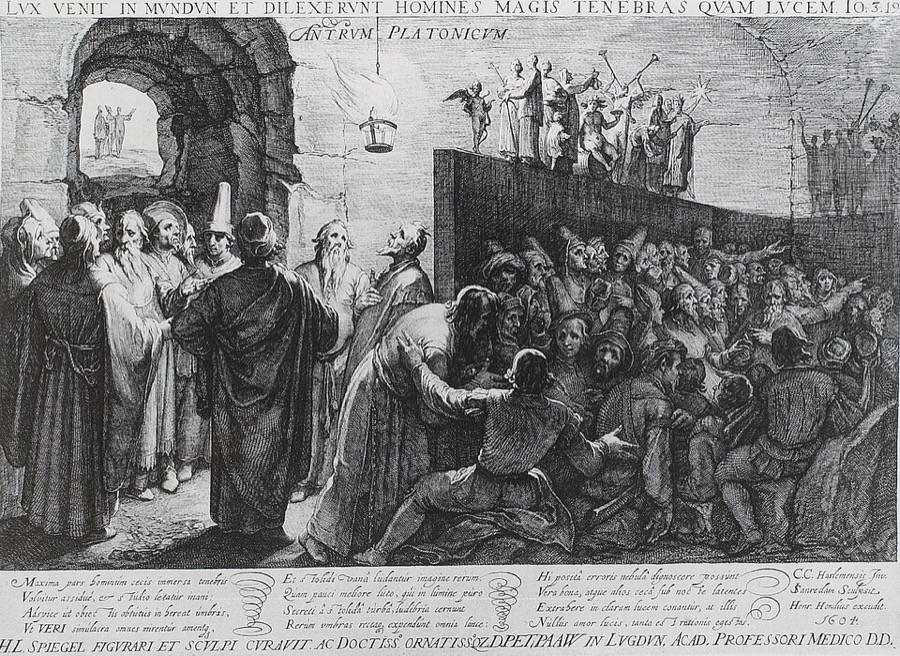
Jan Saenredam, after Cornelis van Haarlem (1604) · public domain
What does the Allegory of the Cave mean?
In Book VII of the Republic, Plato describes prisoners chained since birth, facing a wall on which shadows of objects are cast by a fire behind them. The shadows are their entire world. One prisoner is freed, painfully climbs toward the light, and discovers that the shadows were copies of copies. When he returns to tell the others, they reject him. The cave dramatises Plato's metaphysics — the visible world as a dim copy of the world of Forms — and his philosophy of education: learning is not pouring information into a mind but reorienting it, "turning the soul" toward what is real.
Learning is not pouring information into a mind but turning the soul toward what is real.
How does the Allegory of the Cave apply today?
- A model for why people defend comfortable illusions even when shown evidence
- A frame for understanding media, ideology, and curated information environments
- A classic lens on the discomfort of unlearning and the resistance teachers meet
The deeper point
The cave’s cruelty isn’t the shadows — it’s that the freed prisoner, returning to explain, is mocked and disbelieved. Plato’s real warning is that truth is socially costly: the crowd prefers the shadows it already agrees on to the light it didn’t ask for.
Quotes on this idea
Compared in
Related ideas
Frequently asked
- What is Plato's Allegory of the Cave about?
- It depicts prisoners who mistake shadows on a wall for reality. When one escapes and sees the sun, he grasps the true Forms. It dramatises Plato’s claim that the senses deceive and only reason reaches genuine knowledge.
- What do the shadows in the cave represent?
- The shadows represent the everyday world of appearances — opinions and sense-impressions we accept as real. For Plato they are mere copies of the eternal Forms, which only philosophical reasoning can perceive.
- What does the sun symbolise in the allegory?
- The sun stands for the Form of the Good — the highest object of knowledge that makes all other truths intelligible, just as sunlight makes objects visible.
Keep reading
Actor–observer bias
Your lateness was the traffic; your colleague's lateness is who they are.
Go deeper
Affiliate links. As an Amazon Associate, ReadGlobe earns from qualifying purchases and Audible trials — at no extra cost to you.
The book behind this idea: The Republic by Plato. Hear the whole thing free — start an Audible trial and your first audiobook is on the house.
Read the full summary of The Republic →
More canonical picks:
- Thinking, Fast and Slow — Daniel Kahneman
- The Art of Thinking Clearly — Rolf Dobelli
- The Great Mental Models, Volume 1 — Shane Parrish
- Poor Charlie’s Almanack — Charlie Munger
- Super Thinking — Gabriel Weinberg & Lauren McCann
- Seeking Wisdom — Peter Bevelin
Cite this page
ReadGlobe. The Allegory of the Cave. https://readglobe.com/idea/cave-allegory/
"The Allegory of the Cave." ReadGlobe, readglobe.com/idea/cave-allegory/.
Primary source: Wikipedia
Summary based on Plato's Republic (public domain) and the Stanford Encyclopedia of Philosophy.