Carl Jung
Founder of analytical psychology who mapped the unconscious as a source of meaning.
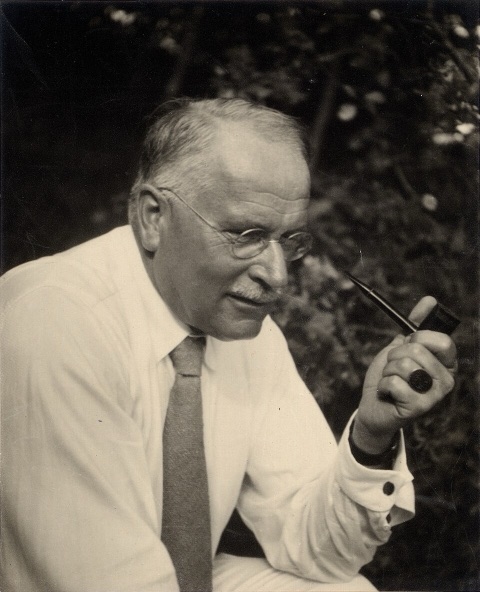
Jung broke with Freud over the nature of the unconscious. Where Freud saw a repository of repressed drives, Jung saw something larger and partly shared — a collective unconscious populated by archetypes, recurring symbolic patterns (the Shadow, the Anima, the Self) that surface across myths, dreams, and religions worldwide. His central project was individuation: the lifelong work of integrating the disowned parts of oneself, especially the Shadow, into a more complete personality. He introduced the now-everyday terms introvert and extravert, and his typology seeded later personality frameworks. Jung treated symbols, religion, and meaning as psychologically real rather than as illusions to be explained away, which made him both influential and controversial. His thought bridges clinical psychology and the humanities, and remains a touchstone for anyone studying myth, dreams, or the search for meaning.
He treated symbols, religion, and meaning as psychologically real rather than illusions to explain away.
Why Carl Jung still matters
Jung is why words like "introvert," "extravert," "archetype," and "the shadow" are part of everyday language. He took the unconscious beyond Freud’s repressed drives into a realm of shared symbols and meaning, and his idea of individuation reframed psychology as a lifelong project of becoming whole.
The one big idea
What you refuse to face in yourself — the shadow — doesn’t vanish; it runs your life from the dark until you make it conscious. Growth (individuation) means integrating it, not defeating it.
Commonly misunderstood
Jung is often lumped in with Freud as a "psychoanalyst." He broke with Freud decisively — over the nature of the unconscious and the centrality of sexuality — and founded a distinct school, analytical psychology, with meaning and symbol at its core.
Key ideas
- The Shadow — Jung's term for the disowned parts of the self — traits we deny and project onto others — which must be integrated to become whole.
Famous quotes
- “Who looks outside, dreams; who looks inside, awakes.” — Letters
- “Until you make the unconscious conscious, it will direct your life and you will call it fate.” — Attributed (paraphrase of Aion / collected works)
- “Everything that irritates us about others can lead us to an understanding of ourselves.” — Memories, Dreams, Reflections
- “Knowing your own darkness is the best method for dealing with the darknesses of other people.” — Letters, Vol. 1
Influenced by
Compare Carl Jung
Frequently asked
- What is the shadow in Jungian psychology?
- The disowned, repressed parts of the self — traits we deny in ourselves and often project onto others. Jung held that integrating the shadow, rather than suppressing it, is essential to becoming whole.
- How did Jung differ from Freud?
- Jung saw the unconscious as a deep reservoir of shared symbols (the collective unconscious), not just repressed personal drives, and rejected Freud’s focus on sexuality as the prime mover — leading to their famous split.
- What is individuation?
- Jung’s term for the lifelong process of integrating conscious and unconscious — including the shadow — into a balanced, whole, and uniquely realized self.
Where to start with Carl Jung
The short answer: Start with Man and His Symbols — the book Jung wrote at the end of his life specifically for general readers. Then his memoir, Memories, Dreams, Reflections. The Collected Works and The Red Book come much later, if at all.
Gentle · start here — no background needed
Man and His Symbols — Carl JungStart here
Jung’s final project, conceived after a dream told him to write for the general public — the only major work he aimed at beginners, finished days before his death.
Memories, Dreams, Reflections — Carl Jung
The memoir — his childhood visions, the break with Freud, the confrontation with the unconscious. The ideas make more sense once you know the life they came from.
Moderate · once the ideas are familiar
Modern Man in Search of a Soul — Carl Jung
The classic essay collection — dream analysis, the stages of life, and his differences from Freud, in Jung’s own voice at mid-career.
The Undiscovered Self — Carl Jung
A short, urgent late essay on the individual against mass society — the most political Jung ever got, and readable in an evening.
Deep end · the demanding texts, worth the climb
The Archetypes and the Collective Unconscious — Carl Jung
Collected Works volume 9i — the primary-source deep dive on archetypes. This is where the real evidence and the real difficulty live.
The Red Book (Liber Novus) — Carl Jung
The illuminated record of his own confrontation with the unconscious, unpublished until 2009. Astonishing — but a primary document, not an explanation. Read it last.
Prefer to listen? Most of this list is on Audible — start a free trial and the first one is on the house.
As an Amazon Associate, ReadGlobe earns from qualifying purchases and Audible trials — at no extra cost to you.
What people get wrong about Carl Jung
- “The shadow is your evil side.”
- Actually: The shadow is everything the ego disowns — including buried strengths and talents. Jungians call the disowned positive material the "golden shadow"; integration, not amputation, is the goal.
- “Jung was Freud’s disciple who borrowed his system.”
- Actually: They collaborated as peers for about six years and broke in 1913 over the nature of libido and religion. Analytical psychology diverges from psychoanalysis at its foundations, not its details.
- “Introvert means shy; extravert means outgoing.”
- Actually: In Psychological Types they name where psychic energy flows — inward to the inner world or outward to objects. A composed public speaker can be a textbook introvert.
Man and His Symbols’ origin (the dream, the final project) is recounted in John Freeman’s introduction to the book itself. The 1913 break and Red Book history: Shamdasani’s introduction to Liber Novus (2009).
Keep reading
Action bias
Goalkeepers would save more penalties standing still — but diving looks like trying.
Cite this page
ReadGlobe. Carl Jung. https://readglobe.com/thinker/carl-jung/
"Carl Jung." ReadGlobe, readglobe.com/thinker/carl-jung/.
Primary source: Wikipedia
Biographical summary synthesised from Wikipedia (CC-BY-SA) and the Stanford Encyclopedia of Philosophy.