Stoicism
A Greco-Roman philosophy holding that virtue is the only true good and that we should focus only on what is within our control.
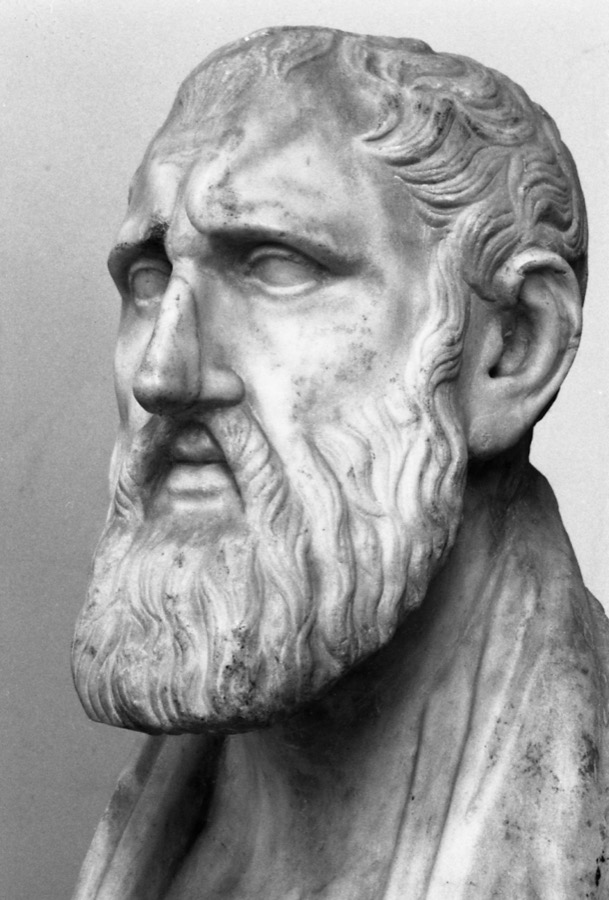
Bust of Zeno of Citium · photo Paolo Monti · CC BY-SA 4.0
Founded by Zeno of Citium in Athens, Stoicism teaches that a good life comes from living according to reason and nature, cultivating the four virtues (wisdom, justice, courage, temperance), and accepting what we cannot change. Its signature practice is the dichotomy of control — distinguishing our own judgements and choices (up to us) from everything else (not up to us). Carried into Rome by Seneca, Epictetus, and Marcus Aurelius, it has had a striking modern revival as a practical toolkit for resilience.
Its signature move is the dichotomy of control — separating what is up to us from what is not.
Core tenets
- The dichotomy of control — some things are up to us (our judgements, choices, actions), most are not (outcomes, reputation, the past). Invest only in the former.
- Virtue is the only true good. Wisdom, justice, courage, and temperance suffice for a flourishing life; everything else is merely "preferred".
- Live according to nature and reason. The cosmos is rational (the logos); aligning your will with it is freedom.
- Premeditatio malorum — rehearse adversity in advance, so misfortune finds you prepared rather than shocked.
- Amor fati — don’t merely accept what happens; embrace it as necessary.
In practice today
In practice, Stoicism is a daily discipline of attention: catching the gap between an event and your reaction, asking "is this up to me?", and reserving emotional investment for your own conduct. Modern cognitive behavioural therapy draws directly on it — the Stoic claim that it is not events but our opinions about them that disturb us is CBT’s founding insight.
Core ideas
- Amor Fati — The Latin phrase "love of fate" — embracing everything that happens, including suffering, not merely tolerating it.
Contrasts with
Compare Stoicism
Frequently asked
- Is Stoicism about suppressing emotion?
- No. Stoicism frees you from being ruled by destructive passions, not from feeling. It cultivates calm judgement, gratitude, even joy — what it removes is the tyranny of fear and craving.
- Why is Stoicism popular again today?
- Its dichotomy of control and "it’s our judgements, not events, that disturb us" are the backbone of modern resilience training and cognitive behavioural therapy — a practical toolkit for stress, focus, and adversity.
- Who are the main Stoic philosophers?
- Zeno of Citium founded it; the most-read today are the Roman Stoics — Seneca, Epictetus, and the emperor Marcus Aurelius, whose private journal the Meditations is a classic.
Where to start with Stoicism
The short answer: Read the three Roman Stoics in this order: Marcus Aurelius’s Meditations first (shortest, most personal), then Seneca’s Letters (warmest), then Epictetus’s Discourses (sternest and most systematic). Add Hadot when you want the scholarship.
Gentle · start here — no background needed
Meditations — Marcus AureliusStart here
A Roman emperor’s private Stoic practice, in fragments you can open anywhere. The most humane door into the school.
Which edition: Gregory Hays (Modern Library).
Letters from a Stoic — Seneca
Moral letters to a friend — on time, wealth, grief, and dying well. The most literary Stoic, and the easiest to love.
A Guide to the Good Life — William B. Irvine
The modern practitioner’s overview — negative visualization and the discipline of desire, organized for contemporary use.
Moderate · once the ideas are familiar
Discourses and Selected Writings — Epictetus
The freed slave who taught the dichotomy of control. Blunter and more demanding than Seneca or Marcus — the school’s spine.
Deep end · the demanding texts, worth the climb
The Inner Citadel — Pierre Hadot
The scholarly capstone: philosophy as a way of life, and the Meditations decoded as spiritual exercises.
Prefer to listen? Most of this list is on Audible — start a free trial and the first one is on the house.
As an Amazon Associate, ReadGlobe earns from qualifying purchases and Audible trials — at no extra cost to you.
What people get wrong about Stoicism
- “Being stoic means showing no feelings.”
- Actually: The lowercase adjective drifted from the school. Stoicism examines the judgments beneath emotions; Seneca’s letters on grief explicitly reject cold indifference to loss.
- “Stoicism teaches passive acceptance of injustice.”
- Actually: The Roman Stoics were senators, advisors, and an emperor — deeply engaged in public life. The dichotomy of control fences off outcomes, not action.
- “Stoicism is a productivity hack invented for entrepreneurs.”
- Actually: It is a 2,300-year-old Greek school founded by Zeno of Citium around 301 BC, with physics, logic, and ethics — the modern self-help slice is one corner of it.
Founding date and school structure: standard histories (Sellars, Stoicism). Seneca on grief: Letters 63 and 99.
Keep reading
Pessimism bias
Expecting the worst isn't foresight — it's your mood dressed up as a forecast.
Cite this page
ReadGlobe. Stoicism. https://readglobe.com/school/stoicism/
"Stoicism." ReadGlobe, readglobe.com/school/stoicism/.
Primary source: Wikipedia
Summary synthesised from the Stanford Encyclopedia of Philosophy and Wikipedia (CC-BY-SA).