Marcus Aurelius
Roman emperor whose private journal became the most-read handbook of Stoic practice.
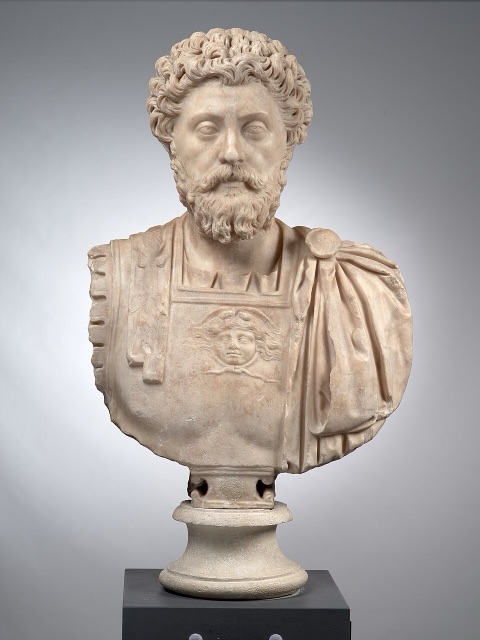
Marcus Aurelius ruled Rome from 161 to 180 CE, yet he is remembered less for governing an empire than for a notebook he never meant to publish. Written on campaign and addressed only to himself, the Meditations is a working manual of Stoic self-correction: reminders to act justly, to accept what cannot be changed, and to treat each obstacle as material for virtue. He inherited Stoicism from Epictetus by way of his tutor Rusticus, and he applied it under extraordinary pressure — plague, war, and betrayal. His central practice is the disciplined separation of what is "up to us" (our judgements and choices) from what is not (fortune, reputation, the actions of others). The result is a philosophy that is austere but humane, demanding self-honesty without self-punishment.
He ruled an empire yet is remembered for a notebook he never meant to publish.
Why Marcus Aurelius still matters
Marcus Aurelius is the rare case of absolute power paired with radical self-restraint. The Meditations weren’t written for publication — they’re a working emperor’s private notes to himself, which is why they read less like philosophy and more like a mind doing maintenance on itself. That intimacy is why the book has outlived the empire it was written in.
The one big idea
You don’t control events, only your judgements about them — and that is enough. Almost every entry returns to this Stoic core: the obstacle is not the thing, but your opinion of the thing.
Commonly misunderstood
He’s often read as cold or detached. In fact the Meditations are full of struggle — he repeatedly has to talk himself out of anger, vanity, and dread. The Stoicism is aspirational, not effortless, which is exactly what makes it usable.
Key ideas
- Amor Fati — The Latin phrase "love of fate" — embracing everything that happens, including suffering, not merely tolerating it.
Famous quotes
- “You have power over your mind — not outside events. Realize this, and you will find strength.” — Meditations
- “Waste no more time arguing about what a good man should be. Be one.” — Meditations, Book X
- “The best revenge is not to be like your enemy.” — Meditations, Book VI
- “The happiness of your life depends upon the quality of your thoughts.” — Meditations (paraphrase)
Influenced by
Influenced
Compare Marcus Aurelius
Frequently asked
- What is the best Marcus Aurelius book?
- There is only one he wrote: the Meditations — a private Stoic journal never meant for publication. The Gregory Hays and Robin Hard translations are the most readable modern editions.
- Was Marcus Aurelius a good emperor?
- He is traditionally counted the last of the "Five Good Emperors," ruling conscientiously through war and plague — though naming his son Commodus as heir is widely judged a failure.
- What can you learn from Marcus Aurelius today?
- The practical Stoic core: separate what is up to you (judgements, actions) from what is not, invest only in the former, and treat adversity as material for character rather than a threat.
Where to start with Marcus Aurelius
The short answer: Start with the Meditations in Gregory Hays’s translation — it is short, direct, and the only book Marcus wrote. Then read his Stoic teachers for context, and finish with Hadot’s scholarly study of how the Meditations actually work.
Gentle · start here — no background needed
Meditations — Marcus AureliusStart here
The emperor’s private notebooks — the entire primary corpus in one short book. Open it anywhere; it was written to be re-read, not read once.
Which edition: Gregory Hays (Modern Library) reads like living English; George Long is the free public-domain text but feels Victorian.
How to Think Like a Roman Emperor — Donald Robertson
A modern companion that interleaves Marcus’s biography with the psychology behind his practices — useful scaffolding before you go deeper into the Stoics themselves.
Moderate · once the ideas are familiar
Letters from a Stoic — Seneca
The other great Roman Stoic voice — warmer and more literary than Marcus. The letters show the same doctrines applied to money, grief, friendship, and time.
Discourses and Selected Writings — Epictetus
Marcus quotes Epictetus constantly in the Meditations — this is the teacher behind the emperor. The dichotomy of control comes from here.
Which edition: Robert Dobbin (Penguin Classics) is the accessible modern rendering.
Deep end · the demanding texts, worth the climb
The Inner Citadel — Pierre Hadot
The landmark scholarly study of the Meditations — Hadot reconstructs the three disciplines the notebook entries are exercises in. Read it last; it re-organizes everything you have read.
Prefer to listen? Most of this list is on Audible — start a free trial and the first one is on the house.
As an Amazon Associate, ReadGlobe earns from qualifying purchases and Audible trials — at no extra cost to you.
What people get wrong about Marcus Aurelius
- “The Meditations was a book Marcus wrote for readers.”
- Actually: It was a private notebook — hypomnemata, exercises written to himself, never titled or intended for publication. That is why it repeats itself: repetition was the practice.
- “Stoicism means suppressing your emotions.”
- Actually: The Stoics taught examining the judgments that produce emotions, not repression. Marcus repeatedly notes that anger and grief arrive; the discipline is in what you assent to about them.
- “Amor fati means passively accepting whatever happens.”
- Actually: For Marcus, accepting fate coexists with relentless action — the Meditations is largely notes on doing his duty well. Acceptance concerns what is outside your control, never your own conduct.
Order and corrections reflect the standard scholarly view of the Meditations as hypomnemata (Hadot, The Inner Citadel) and mainstream Stoic scholarship on emotion and the dichotomy of control.
Keep reading
Jevons paradox
Efficiency is a price cut in disguise — which is why better steam engines burned more coal, not less.
Cite this page
ReadGlobe. Marcus Aurelius. https://readglobe.com/thinker/marcus-aurelius/
"Marcus Aurelius." ReadGlobe, readglobe.com/thinker/marcus-aurelius/.
Primary source: Wikipedia
Biographical summary synthesised from Wikipedia (CC-BY-SA) and the Stanford Encyclopedia of Philosophy.