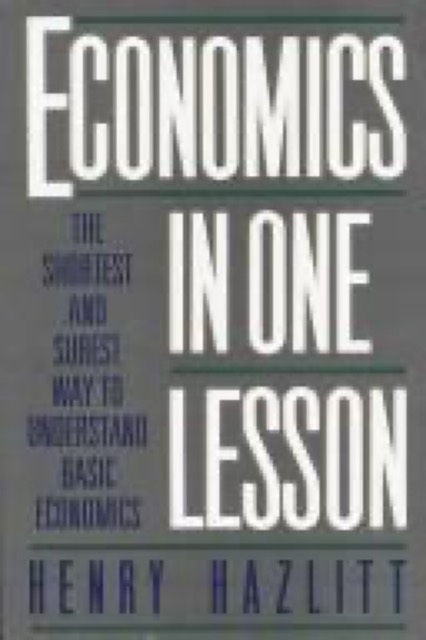
Economics in One Lesson
by Henry Hazlitt
The single lesson: economics is tracing the consequences of an act for every group, not just the group in front of you, and over the long run rather than the moment. Most bad policy is good short-run accounting.
What does Economics in One Lesson teach?
Hazlitt takes one principle, borrowed and sharpened from Bastiat, and applies it relentlessly. The book opens with the broken window: a vandal smashes a baker's window, the glazier is paid, money circulates, and a bystander concludes the town is better off. The error is that the suit the baker would otherwise have bought is now never made — it is unseen, and being unseen it is excluded from the ledger. Every subsequent chapter is the same move applied to a different policy: tariffs, price controls, subsidies, make-work schemes, minimum wages. In each case a visible beneficiary is set against a diffuse cost carried by people who will never know what they lost. Read as economics the book is polemical and one-sided; it argues a position and does not steelman the opposition. Read as training in a single mental habit it is unmatched, because it makes opportunity cost concrete over and over until the unseen alternative becomes the first thing you look for.
Which ideas does Economics in One Lesson explain?
Read the idea in two minutes, then read the book behind it.
Read or listen to Economics in One Lesson
Hear the whole book free: start an Audible trial and your first audiobook — this one, if you like — is on the house.
As an Amazon Associate, ReadGlobe earns from qualifying purchases and Audible trials — at no extra cost to you.