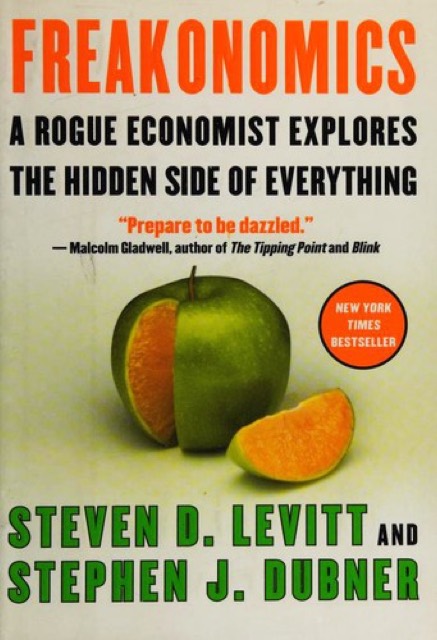
Freakonomics
by Steven Levitt & Stephen Dubner
Apply economic tools to questions economics usually ignores and the answers are frequently counter-intuitive — because people respond to the incentives actually in front of them rather than the ones the rules intended.
What does Freakonomics teach?
The book has no thesis in the conventional sense; it has a method, applied to deliberately unlikely questions. Do schoolteachers cheat when their pay depends on test scores — yes, and the pattern of answers gives them away. Do estate agents sell their own houses on the same terms they advise for clients — no, they wait longer and get more, because the commission on the marginal price movement is negligible to them and large to you. The recurring lesson is that incentives are threefold — economic, social and moral — and that designing one while ignoring the others produces the cobra effect, where a scheme creates precisely the behaviour it was meant to suppress. Levitt's method is natural experiments and careful identification rather than theory, and the writing makes the identification strategy legible to non-economists, which is its real contribution. Some claims, notably the abortion-and-crime chapter, have been substantially contested since publication and should be read as argued rather than established. As training in asking what the rule actually rewards, it holds up.
Which ideas does Freakonomics explain?
Read the idea in two minutes, then read the book behind it.
Read or listen to Freakonomics
Hear the whole book free: start an Audible trial and your first audiobook — this one, if you like — is on the house.
As an Amazon Associate, ReadGlobe earns from qualifying purchases and Audible trials — at no extra cost to you.