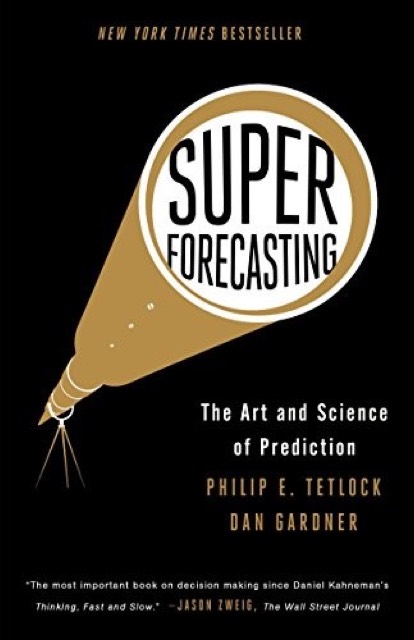
Superforecasting
by Philip Tetlock & Dan Gardner
When predictions are scored rather than remembered, expert commentators perform near chance while a minority of ordinary forecasters do consistently better — by working in fine-grained probabilities and updating on evidence.
What does Superforecasting teach?
Tetlock's earlier work scored thousands of expert predictions and found the average barely beat random guessing, with fame inversely related to accuracy. Superforecasting reports what came next: a tournament that identified individuals who genuinely outperformed, and an anatomy of how they worked. They start from the base rate — the outside view, how often this class of thing happens at all — before adjusting for the specifics of the case. They decompose a vague question into tractable parts. They use fine granularity, distinguishing sixty per cent from sixty-five rather than rounding to likely, and they update in small increments as evidence arrives, neither anchoring on the first estimate nor overreacting to the latest headline. Temperament matters more than intelligence or access: the strongest predictor was actively open-minded thinking, treating a belief as a hypothesis to be tested rather than a possession to be defended. The book's most useful implication is procedural — keep a scored record of your own forecasts, because without one you will remember yourself as considerably more accurate than you were.
Which ideas does Superforecasting explain?
Read the idea in two minutes, then read the book behind it.
Read or listen to Superforecasting
Hear the whole book free: start an Audible trial and your first audiobook — this one, if you like — is on the house.
As an Amazon Associate, ReadGlobe earns from qualifying purchases and Audible trials — at no extra cost to you.