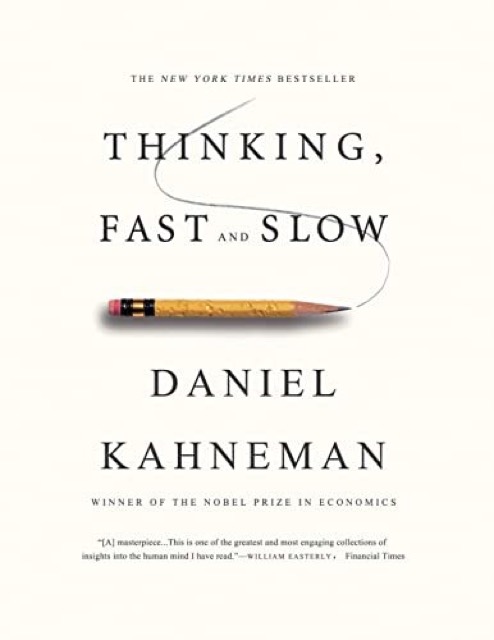
Thinking, Fast and Slow
by Daniel Kahneman
The mind runs on two systems: a fast, intuitive one that leaps to conclusions and a slow, deliberate one that reasons — and the fast one, riddled with predictable biases, quietly makes most of your decisions.
What does Thinking, Fast and Slow teach?
Kahneman, who won the Nobel in economics for work that dismantled the assumption of human rationality, maps thought onto two agents. System 1 is automatic and effortless; System 2 is slow, effortful, and lazy, often endorsing whatever System 1 suggests. The trouble is that System 1's shortcuts misfire in systematic ways. We anchor on arbitrary numbers, judge risk by how easily examples come to mind, and feel losses roughly twice as sharply as equivalent gains. How a choice is framed — as survival odds or death odds — reverses our decisions. We seek evidence that confirms what we already believe. Kahneman's argument is not that we should distrust intuition, but that we should recognize the conditions under which it fails and slow down accordingly. Essential for anyone who makes consequential judgments and suspects their own confidence.
Which ideas does Thinking, Fast and Slow explain?
Read the idea in two minutes, then read the book behind it.
Read or listen to Thinking, Fast and Slow
Hear the whole book free: start an Audible trial and your first audiobook — this one, if you like — is on the house.
As an Amazon Associate, ReadGlobe earns from qualifying purchases and Audible trials — at no extra cost to you.