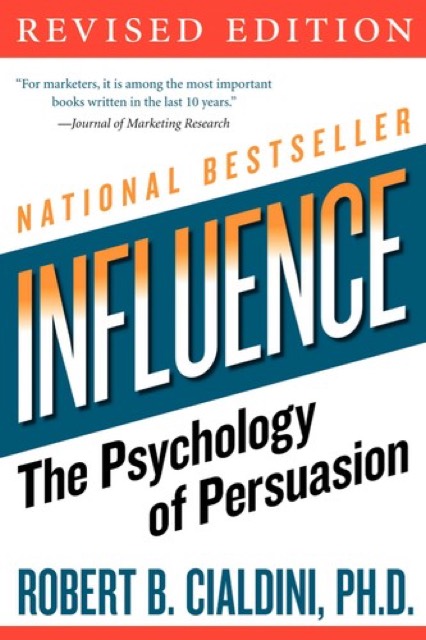
Influence: The Psychology of Persuasion
by Robert Cialdini
Influence argues that most persuasion works through six automatic mental shortcuts—reciprocity, commitment and consistency, social proof, authority, liking, and scarcity—that compliance professionals exploit to trigger a "yes" before deliberate thought intervenes.
What does Influence: The Psychology of Persuasion teach?
Cialdini, a social psychologist, spent years inside sales, fundraising, and advertising operations to learn how compliance is engineered. His thesis: the brain relies on fixed-action shortcuts to cope with a complex world, and these shortcuts can be reliably triggered. He documents six levers. Reciprocity: an unsolicited gift creates pressure to repay. Commitment and consistency: a small first "yes" locks people into larger ones. Social proof: uncertainty makes us copy the crowd. Authority bias: titles and uniforms secure obedience. Liking: we say yes to people who resemble or flatter us. Scarcity: perceived rarity inflates value. Each mechanism is shown working, then turned into a defense—recognizing when a shortcut is being weaponized. Useful for anyone who sells, negotiates, markets, or simply wants to resist manipulation.
Which ideas does Influence: The Psychology of Persuasion explain?
Read the idea in two minutes, then read the book behind it.
Read or listen to Influence: The Psychology of Persuasion
Hear the whole book free: start an Audible trial and your first audiobook — this one, if you like — is on the house.
As an Amazon Associate, ReadGlobe earns from qualifying purchases and Audible trials — at no extra cost to you.