Bandwagon effect
The bandwagon effect is the tendency to adopt beliefs or behaviours because many others already have. As something gains popularity, the rate of adoption rises — people follow the crowd, often regardless of the underlying evidence.
✦ Widely referenced — cross-referenced 16× across this reference (8 related ideas · 3 comparisons · 4 hubs · 1 book) · The State of Thinking 2026 →
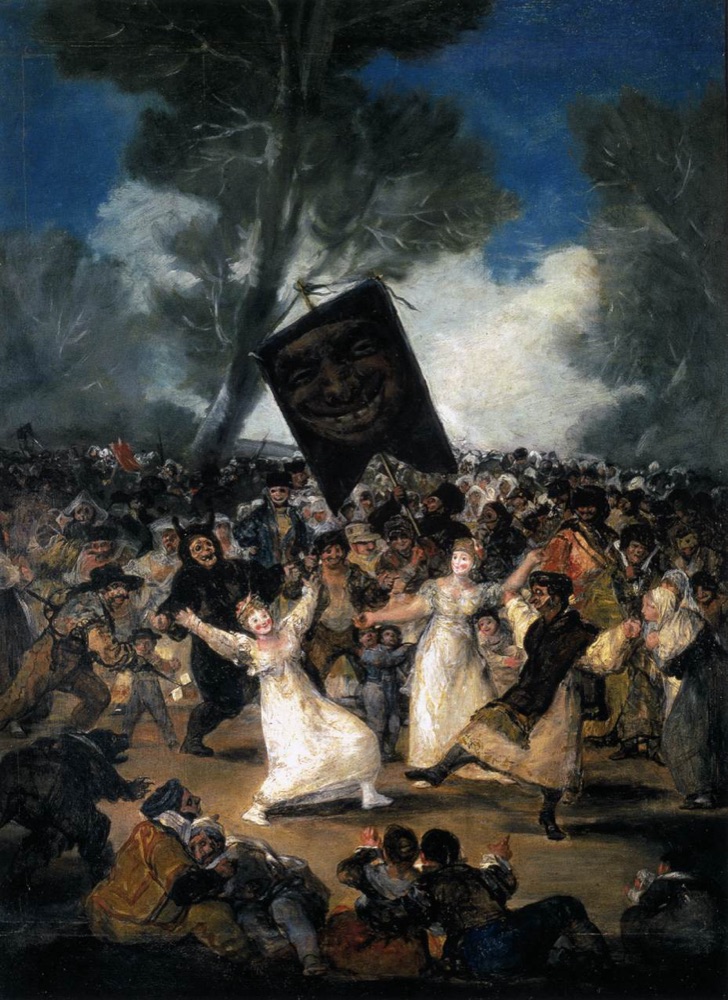
Goya's carnival mob surges as a single body behind a grinning banner, individuals dissolved into the crowd's forward momentum — the visual of joining a movement simply because everyone around you already has.
Francisco Goya, The Burial of the Sardine (1812–1814) · Public domain
Why does the bandwagon effect happen?
Social proof is a fast heuristic — if many believe it, it’s probably right or at least safe — and conformity spares us the discomfort of standing apart. Popularity itself starts to function as evidence.
Popularity is evidence — of popularity, and nothing else.
What does the bandwagon effect look like in real life?
- A stock or trend surging simply because more people are piling in.
- Opinions shifting once a view appears to be the majority’s.
- Buying a product mainly because it’s a best-seller.
How do you counter the bandwagon effect?
- Judge the claim on its own evidence, not its popularity.
- Ask whether you’d still hold the view if no one else did.
- Deliberately seek out the dissenting case.
The deeper point
Popularity is evidence — of popularity, and nothing else. The bandwagon works because "everyone believes it" is a genuinely useful shortcut, right up until it cascades into a bubble or a panic with no one checking the merits.
Frequently asked
- What is the bandwagon effect?
- Believing or doing something largely because many others already do — adoption that feeds on its own popularity rather than on the merits.
- Why is the bandwagon effect powerful?
- It combines social proof (the crowd is a shortcut for “correct”) with the comfort of conformity, so popularity snowballs independent of evidence.
- How do you resist the bandwagon effect?
- Evaluate the claim on its own evidence, ask whether you’d hold it alone, and actively look for the strongest opposing view.
Compared side by side
Keep reading
First-principles thinking
Priced as raw cobalt and nickel, the $600 battery pack turned out to be mostly habit.
See this alongside the other thinking tools of investing.
This bias distorts meetings, product decisions and shopping & spending.
Go deeper
Affiliate links. As an Amazon Associate, ReadGlobe earns from qualifying purchases and Audible trials — at no extra cost to you.
The book behind this idea: Influence by Robert Cialdini. Hear the whole thing free — start an Audible trial and your first audiobook is on the house.
Read the full summary of Influence →
More canonical picks:
- Thinking, Fast and Slow — Daniel Kahneman
- The Art of Thinking Clearly — Rolf Dobelli
- The Great Mental Models, Volume 1 — Shane Parrish
- Poor Charlie’s Almanack — Charlie Munger
- Super Thinking — Gabriel Weinberg & Lauren McCann
- Seeking Wisdom — Peter Bevelin
Cite this page
ReadGlobe. (2026). Bandwagon effect. https://readglobe.com/bias/bandwagon-effect/
"Bandwagon effect." ReadGlobe, 29 May 2026, readglobe.com/bias/bandwagon-effect/.
Primary source: Wikipedia
Editorial synthesis © ReadGlobe 2026, drawing on Kahneman’s Thinking, Fast and Slow, the Tversky–Kahneman research program, and the primary cognitive-science literature. · Last reviewed 2026-05-29.