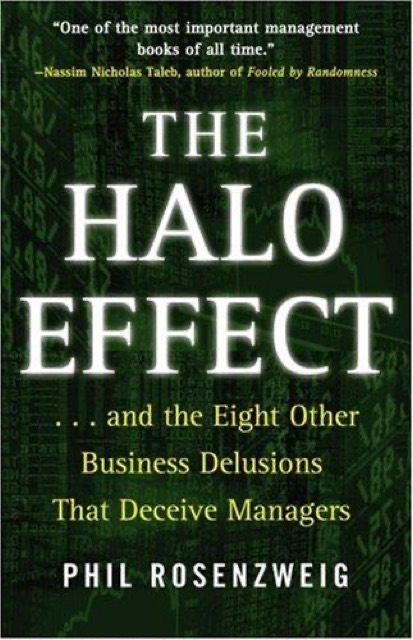
The Halo Effect
by Phil Rosenzweig
When a company does well we rate its culture, strategy and leadership highly; when the same company falters those ratings invert though little changed. Much business research measures the halo, then reports it as the cause.
What does The Halo Effect teach?
Rosenzweig's target is a genre. Studies that identify high performers and interview their staff about culture, focus or leadership are, he argues, largely recording the glow that success casts backwards over every attribute. He names nine delusions and the surrounding statistical errors: selecting on the dependent variable, so only survivors are examined; treating correlation as instruction; ignoring regression to the mean, which guarantees that companies chosen for extreme performance will look worse afterwards regardless of what they do. Celebrated studies are re-examined and their samples shown to have drifted back toward average once the book was published. What replaces them is deliberately less comforting. Rosenzweig argues that strategy involves irreducible uncertainty and that good decisions can yield bad outcomes, so managers should judge process rather than result and accept that no formula guarantees performance. It is the most useful antidote available to the success-story shelf, and it doubles as a practical course in how survivorship bias is manufactured.
Which ideas does The Halo Effect explain?
Read the idea in two minutes, then read the book behind it.
Read or listen to The Halo Effect
Hear the whole book free: start an Audible trial and your first audiobook — this one, if you like — is on the house.
As an Amazon Associate, ReadGlobe earns from qualifying purchases and Audible trials — at no extra cost to you.