Natural selection
Natural selection is the process by which traits that aid survival and reproduction become more common over generations. As a general mental model, any system with variation, selection, and heredity will evolve — not just life, but ideas, products, companies, and cultures.
- 1 min read
- 3 books teach this
- 3 linked ideas
How does natural selection work?
Look for the three ingredients — variation (differences), selection (some survive or spread more), and heredity (winners are copied). Wherever all three exist, expect evolution: the system will, over time, become adapted to whatever is being selected for, with no designer required.
'What is being selected for here?' explains more than 'who designed this?'
How do you use natural selection?
- Understanding how markets, ideas, and cultures evolve without central design.
- Designing systems that improve by generating variation and selecting winners (A/B tests, iteration).
- Recognising that "what survives" is shaped by the selection pressure, not by what’s "best."
What does natural selection look like in practice?
Businesses in a market evolve like organisms: many variations launch (variation), most fail while a few thrive (selection), and successful models get copied (heredity). Over time the market fills with firms adapted to whatever customers reward — no master plan needed.
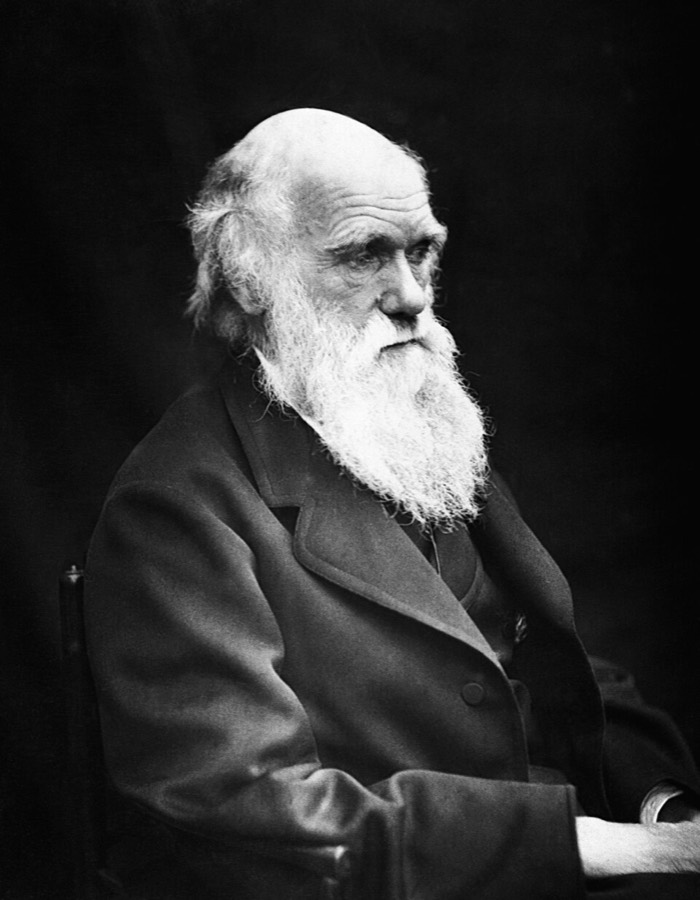
Charles Darwin · photo Julia Margaret Cameron (1868) · public domain
Where does natural selection fail?
It selects for survival and reproduction, not goodness — evolution produces parasites and addictive products as readily as beneficial ones. Assuming "it survived, so it must be good" (a naturalistic fallacy) misreads what selection actually optimises for.
- Selection acts slowly and always lags a changing environment, so a well-adapted trait can become a liability before the process corrects it.
- It tinkers incrementally with whatever already exists and cannot leap across a valley to a better design that requires several unrewarded steps.
- Selection needs a stable pressure to push against; when the environment shifts randomly, past adaptation carries no predictive weight.
The counter-model: First-principles thinking — Selection can only refine what exists step by step, while first-principles reasoning can jump to a redesigned optimum selection would never reach.
How do you apply natural selection, step by step?
- Name the system and identify its unit of variation, its selection pressure, and how successful units get copied.
- Ask what is actually being rewarded here, which is rarely the quality you assumed.
- Check whether the pressure is stable enough for past winners to predict future ones.
- Decide whether to let the process run or to intervene where selection optimises for the wrong thing.
The deeper point
Its most powerful use is as a lens for things that look designed but aren’t: markets, languages, institutions, and your own habits are all evolved, not planned. "What is being selected for here?" explains more than "who designed this?"
Frequently asked
- What is natural selection as a mental model?
- It’s the insight that any system with variation, selection, and heredity will evolve and adapt over time — not just living things, but ideas, products, companies, and cultures. No designer is required.
- What are the three ingredients of natural selection?
- Variation (differences between individuals or options), selection (some survive or spread more than others), and heredity (the successful ones are copied or passed on). Wherever all three exist, evolution follows.
- Does natural selection produce the "best" outcome?
- No — it selects for whatever survives and reproduces, not for what’s good or optimal. It can favour parasites, addictive products, and harmful memes as readily as beneficial traits. "It survived" doesn’t mean "it’s good."
Related
Keep reading
Tragedy of the commons
Every herder adds one more cow for rational reasons; the pasture dies anyway.
Go deeper
Affiliate links. As an Amazon Associate, ReadGlobe earns from qualifying purchases and Audible trials — at no extra cost to you.
The book behind this idea: The Selfish Gene by Richard Dawkins. Hear the whole thing free — start an Audible trial and your first audiobook is on the house.
Read the full summary of The Selfish Gene →
More canonical picks:
- Thinking, Fast and Slow — Daniel Kahneman
- The Art of Thinking Clearly — Rolf Dobelli
- The Great Mental Models, Volume 1 — Shane Parrish
- Poor Charlie’s Almanack — Charlie Munger
- Super Thinking — Gabriel Weinberg & Lauren McCann
- Seeking Wisdom — Peter Bevelin
Cite this page
ReadGlobe. (2026). Natural selection. https://readglobe.com/model/natural-selection/
"Natural selection." ReadGlobe, 29 May 2026, readglobe.com/model/natural-selection/.
Primary source: Wikipedia
Editorial synthesis © ReadGlobe 2026, drawing on the mental-models tradition (Charlie Munger, Farnam Street) and the primary sources for each model. · Last reviewed 2026-05-29.