Dunning–Kruger effect
The Dunning–Kruger effect is the tendency for people with low competence in a domain to overestimate their ability — because the very skills needed to perform well are also the skills needed to recognize poor performance. Experts, conversely, often underrate themselves.
✦ Widely referenced — cross-referenced 16× across this reference (9 related ideas · 3 comparisons · 3 hubs) · The State of Thinking 2026 →
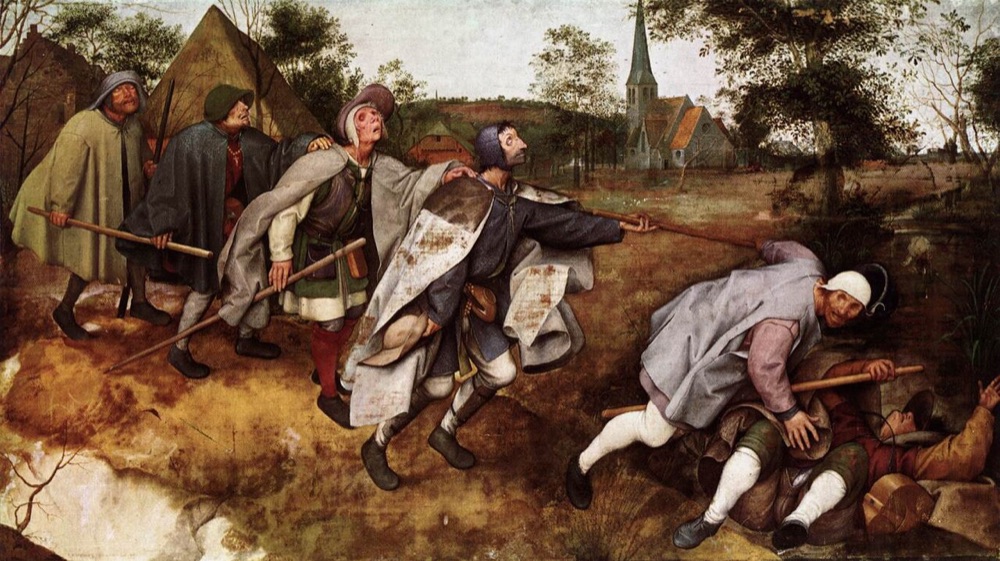
Each blind man confidently follows a guide as sightless as himself and never perceives his own incapacity until he is already falling — Dunning–Kruger made literal, where the very deficiency that dooms them is the one they cannot see.
Pieter Bruegel the Elder, The Parable of the Blind (1568) · Public domain
Why does the Dunning–Kruger effect happen?
Accurate self-assessment is itself a skill. Novices lack the knowledge to see what they don’t know, so confidence outruns competence. Experts, fluent in the domain’s real depth, assume tasks easy for them are easy for everyone and discount their own ability.
Competence and the ability to judge it are the same skill — so you can't trust your self-assessment where you haven't earned it.
What does the Dunning–Kruger effect look like in real life?
- Feeling “basically an expert” after a single tutorial or one popular-science book.
- Confident, sweeping predictions in a field you’ve barely studied.
- A genuine specialist underrating their rare skill because it feels obvious to them.
How do you counter the Dunning–Kruger effect?
- Seek external feedback and objective benchmarks rather than trusting your gut estimate.
- Assume early confidence is inflated; the more you learn, the more depth you’ll see.
- Ask an expert what a true beginner usually fails to notice.
The deeper point
The unsettling part isn’t that beginners are overconfident — it’s that competence and the ability to judge competence are the same skill. You can’t trust your self-assessment in any domain you haven’t yet earned.
Frequently asked
- What is the Dunning–Kruger effect in one sentence?
- People who know little about a subject tend to overestimate how much they know, because they lack the knowledge required to recognize their own gaps.
- Do experts suffer from Dunning–Kruger too?
- In reverse — experts often underestimate their ability, assuming what’s easy for them is easy for others. The effect distorts self-assessment at both ends of the skill curve.
- How do you escape the Dunning–Kruger trap?
- Get objective feedback, benchmark against others, and learn enough about a field to appreciate how much it actually contains. Humility scales with real knowledge.
Compared side by side
Keep reading
The endowment effect
Students holding a mug demanded twice what others would pay for the identical one.
See this alongside the other thinking tools of career growth and learning.
This bias distorts studying & learning.
The books behind better thinking
Affiliate links. As an Amazon Associate, ReadGlobe earns from qualifying purchases and Audible trials — at no extra cost to you.
Listen to any of these free. Start a free Audible trial and get your first audiobook on the house.
Prefer to read? The canonical picks:
- Thinking, Fast and Slow — Daniel Kahneman
- The Art of Thinking Clearly — Rolf Dobelli
- The Great Mental Models, Volume 1 — Shane Parrish
- Poor Charlie’s Almanack — Charlie Munger
- Super Thinking — Gabriel Weinberg & Lauren McCann
- Seeking Wisdom — Peter Bevelin
Cite this page
ReadGlobe. (2026). Dunning–Kruger effect. https://readglobe.com/bias/dunning-kruger-effect/
"Dunning–Kruger effect." ReadGlobe, 29 May 2026, readglobe.com/bias/dunning-kruger-effect/.
Primary source: Wikipedia
Editorial synthesis © ReadGlobe 2026, drawing on Kahneman’s Thinking, Fast and Slow, the Tversky–Kahneman research program, and the primary cognitive-science literature. · Last reviewed 2026-05-29.