Taoism
A Chinese philosophy of living in harmony with the Tao — the natural way of things — through simplicity, humility, and effortless action.
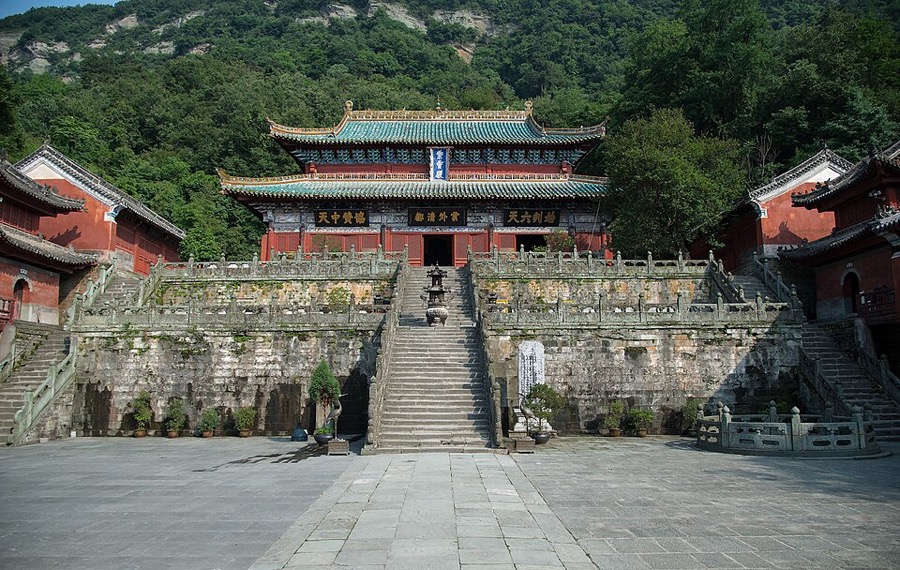
Zixiao Palace, Wudang Mountains · photo liuzr99 · CC BY-SA 2.0
Rooted in the Tao Te Ching attributed to Lao Tzu and developed by Zhuangzi, philosophical Taoism prizes spontaneity, non-contention, and alignment with nature over striving and rigid control. Its central practice, wu wei, is effortless or non-forcing action. Taoism shaped Chinese art, medicine, and statecraft, and deeply influenced Chan and Zen Buddhism. Its imagery — water, the uncarved block, the empty vessel — celebrates strength found in softness and fullness found in emptiness.
Strength found in softness, fullness found in emptiness — align with nature rather than force it.
Core tenets
- Wu wei — effortless, non-forcing action; accomplishing by aligning with the natural flow rather than struggling against it.
- The Tao is ineffable — "the way that can be named is not the eternal Way"; reality outruns our concepts.
- Simplicity and humility — the "uncarved block" (pu): returning to a natural, unpretentious state.
- Yielding overcomes force — like water, the soft and flexible outlasts the hard and rigid.
- Non-contention — succeeding without striving, leading without dominating.
In practice today
Practising Taoism is less a set of rules than a loosening — dropping rigid ambition and over-control, noticing where you force what could flow, and acting with the grain of a situation. Its influence runs through Chinese medicine, martial arts, landscape painting, and Zen, all of which prize spontaneity and harmony over domination.
Core ideas
- Wu Wei — The Taoist principle of "effortless action" — accomplishing things by aligning with the natural flow rather than forcing them.
Contrasts with
Compare Taoism
Frequently asked
- What is wu wei?
- Often translated "non-action," it really means effortless, non-forcing action — accomplishing by working with the natural flow rather than against it, like water finding its path.
- What is the Tao?
- The "Way" — the underlying natural order and source of all things. Taoism holds it can’t be fully captured in words ("the Tao that can be named is not the eternal Tao"); it is lived, not defined.
- How does Taoism differ from Confucianism?
- Confucianism stresses social order, ritual, and duty; Taoism stresses spontaneity, simplicity, and harmony with nature. One civilises; the other naturalises.
Go deeper
Affiliate links. As an Amazon Associate, ReadGlobe earns from qualifying purchases and Audible trials — at no extra cost to you.
The book behind this idea: Tao Te Ching by Lao Tzu. Hear the whole thing free — start an Audible trial and your first audiobook is on the house.
Read the full summary of Tao Te Ching →
More canonical picks:
- Thinking, Fast and Slow — Daniel Kahneman
- The Art of Thinking Clearly — Rolf Dobelli
- The Great Mental Models, Volume 1 — Shane Parrish
- Poor Charlie’s Almanack — Charlie Munger
- Super Thinking — Gabriel Weinberg & Lauren McCann
- Seeking Wisdom — Peter Bevelin
Keep reading
The Peter principle
Promote your best engineer into management and the team takes two losses at once.
Cite this page
ReadGlobe. Taoism. https://readglobe.com/school/taoism/
"Taoism." ReadGlobe, readglobe.com/school/taoism/.
Primary source: Wikipedia
Summary synthesised from the Stanford Encyclopedia of Philosophy and Wikipedia (CC-BY-SA).