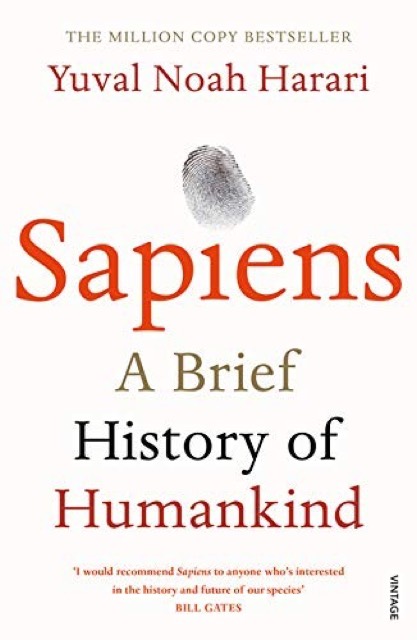
Sapiens
by Yuval Noah Harari
Homo sapiens came to dominate not through individual intelligence but through flexible cooperation in very large numbers, which depends on shared belief in things that exist only in collective imagination — money, nations, laws, companies.
What does Sapiens teach?
Harari organises human history around three ruptures. The cognitive revolution gave language capable of describing what does not exist, and that capacity for shared fiction is his central claim: a limited liability company, a currency and a nation are all real in exactly the sense that enough people act as though they are, and that is sufficient to coordinate millions of strangers who will never meet. The agricultural revolution he reads against the usual grain, as an arrangement that multiplied the species while making the average life harder — more calories, more people, worse diet, more labour. The scientific revolution begins with the admission of ignorance, which made systematic enquiry and the alliance of science with empire and capital possible. Specialists dispute individual claims and the book compresses hard, contested history into confident narrative; it is best read as a provocative synthesis rather than a settled account. Its lasting contribution is the lens: once you see money and nations as intersubjective constructs, a great deal of the built world looks different.
Which ideas does Sapiens explain?
Read the idea in two minutes, then read the book behind it.
Read or listen to Sapiens
Hear the whole book free: start an Audible trial and your first audiobook — this one, if you like — is on the house.
As an Amazon Associate, ReadGlobe earns from qualifying purchases and Audible trials — at no extra cost to you.