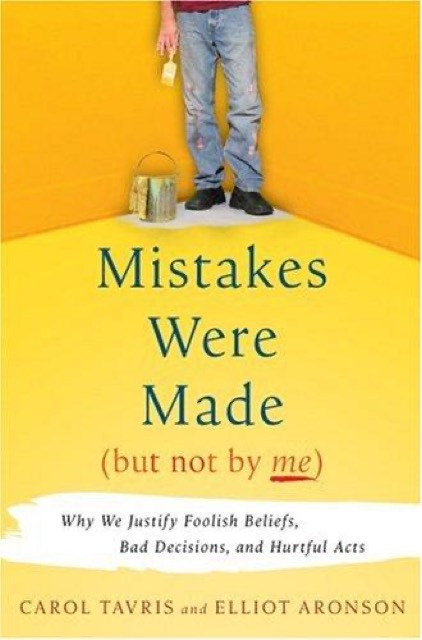
Mistakes Were Made (But Not by Me)
by Carol Tavris & Elliot Aronson
Cognitive dissonance makes being wrong feel intolerable, so we revise the story instead of the belief. Each small self-justification narrows the next choice, until people who began with a minor error defend a major one sincerely.
What does Mistakes Were Made (But Not by Me) teach?
Tavris and Aronson take one mechanism — the discomfort of holding a belief and a contradicting fact at once — and follow it through the places it does real damage: prosecutors who will not revisit a conviction after exculpatory evidence arrives, therapists committed to recovered memories, couples rewriting a shared history, governments escalating a failing policy. Their central image is a pyramid. Two people begin almost identically, make a slightly different choice, then justify it; each justification moves them further apart until they are at opposite corners and each believes they were always there. The book's most useful contribution is showing that self-justification is not lying. The person genuinely believes the revised account, because the memory itself has been edited to remove the dissonance. That is why demanding an admission usually hardens a position rather than dissolving it, and why the backfire effect is so reliable. The practical lesson is not to catch other people in the act; it is to notice the small first justification in yourself, while the pyramid is still narrow.
Which ideas does Mistakes Were Made (But Not by Me) explain?
Read the idea in two minutes, then read the book behind it.
Read or listen to Mistakes Were Made (But Not by Me)
Hear the whole book free: start an Audible trial and your first audiobook — this one, if you like — is on the house.
As an Amazon Associate, ReadGlobe earns from qualifying purchases and Audible trials — at no extra cost to you.