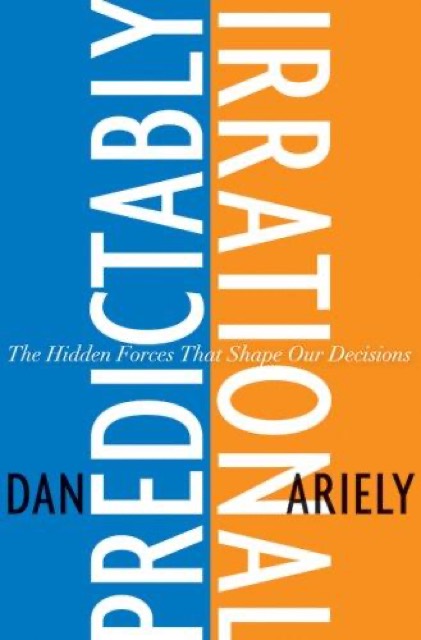
Predictably Irrational
by Dan Ariely
We do not deviate from rational choice at random. The same errors recur in the same conditions, which means they can be predicted, engineered against us in a shop or a contract, and designed around once you can name them.
What does Predictably Irrational teach?
Ariely ran the experiments rather than theorised about them, and the book reads as a sequence of demonstrations. A third, deliberately unattractive subscription option makes a mid-priced one look obvious — the decoy effect, shown with a real Economist advertisement. People value a desk they assembled far above an identical one they did not, an effect Ariely co-named after the flat-pack furniture that produces it. An arbitrary number, even the last digits of a social-security number, drags subsequent price judgments toward it. Free is not simply a low price but a category change that suspends comparison altogether. What holds the demonstrations together is the claim in the title: these are not lapses but regularities. Where Kahneman explains the architecture underneath, Ariely shows the architecture being used — in pricing, menus, defaults and contracts. Read it for the uncomfortable recognition of choices you thought you made freely, and for a working vocabulary you can apply the next time a third option appears that nobody seems to want.
Which ideas does Predictably Irrational explain?
Read the idea in two minutes, then read the book behind it.
Read or listen to Predictably Irrational
Hear the whole book free: start an Audible trial and your first audiobook — this one, if you like — is on the house.
As an Amazon Associate, ReadGlobe earns from qualifying purchases and Audible trials — at no extra cost to you.