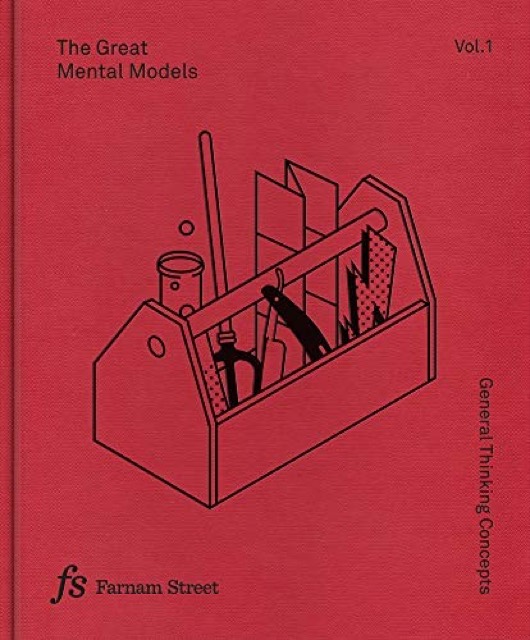
The Great Mental Models, Volume 1
by Shane Parrish
A small set of models drawn from across disciplines does most of the work in most decisions. The volume covers the general ones — the map and the territory, circle of competence, first principles, inversion, second-order thinking.
What does The Great Mental Models, Volume 1 teach?
Parrish's premise is Munger's: a person with a handful of models from several disciplines out-thinks a specialist holding one, because most problems do not respect subject boundaries. The book gives each model a chapter and works it until it is usable rather than merely recognised. The map is not the territory — every model is a reduction, and the failures come from forgetting the reduction was made. Circle of competence — the boundary matters more than the area, and the expensive mistakes cluster just outside it while confidence is still high. First principles — decompose to what you actually know is true, then rebuild, rather than reasoning by analogy to what already exists. Inversion — ask what would guarantee failure and avoid that, which is frequently more tractable than pursuing success. Second-order thinking — and then what happens. It is the most accessible entry point to the latticework idea, and deliberately so: little of it is original, and the value is in the assembly and the worked examples.
Which ideas does The Great Mental Models, Volume 1 explain?
Read the idea in two minutes, then read the book behind it.
Read or listen to The Great Mental Models, Volume 1
Hear the whole book free: start an Audible trial and your first audiobook — this one, if you like — is on the house.
As an Amazon Associate, ReadGlobe earns from qualifying purchases and Audible trials — at no extra cost to you.