Leverage
Leverage is using a small input to produce a disproportionately large output — Archimedes’ "give me a lever long enough and I will move the world." As a mental model, it asks where a little effort, capital, or insight can be amplified into outsized results.
- 1 min read
- 3 books teach this
- 3 linked ideas
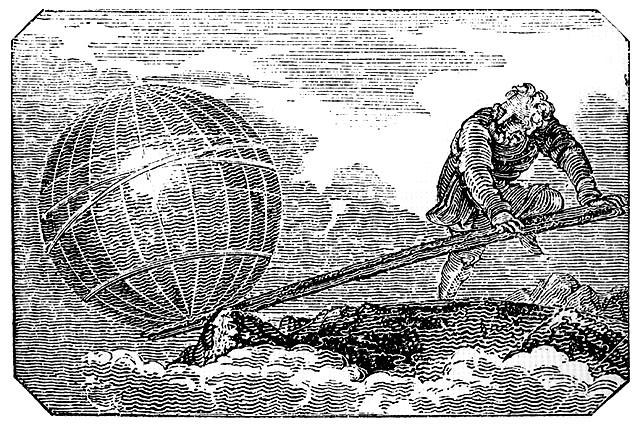
The period engraving of Archimedes tilting the whole earth with a single lever and fulcrum is the literal image behind the model's founding boast — that a small, well-placed force moves an immense load.
Mechanics Magazine, Archimedes' lever moving the earth (1824) · Public domain
How does leverage work?
Look for amplifiers: capital, code, media, labour, relationships, and systems that multiply your effort. Rather than working harder linearly, find the lever — the point where the same input produces many times the output.
Selling your time caps your income because time is the one input with no leverage.
How do you use leverage?
- Choosing high-leverage activities (build once, benefit forever) over linear effort.
- Identifying the lever in a situation — capital, automation, audience, or a key relationship.
- Recognising that the wealthy and effective own leverage; they don’t just sell their time.
What does leverage look like in practice?
A carpenter who builds tables earns per table — linear effort. One who writes a book on woodworking, or builds a tool other carpenters buy, sells the same work thousands of times. Code and media are leverage: the effort is paid once, the output scales without limit.
Where does leverage fail?
Leverage amplifies losses as much as gains — financial leverage (debt) magnifies a downturn into ruin, and any lever can swing both ways. High leverage without a margin of safety turns a small mistake into a catastrophe.
- Every lever needs a fulcrum — leverage borrowed from platforms, employers, or lenders can be withdrawn by them at the worst possible moment.
- Leveraged positions reduce your ability to wait; many leveraged failures come from forced exits, not from being wrong.
- Leverage concentrates outcomes on the quality of one judgment, so it rewards only those whose underlying decision process is already sound.
The counter-model: Redundancy — Leverage strips out slack to amplify output; redundancy deliberately adds slack so a single failure cannot cascade.
How do you apply leverage, step by step?
- Identify where a fixed asset — code, capital, audience, tools — could multiply your effort.
- Estimate both the amplified upside and the amplified downside of using it.
- Cap the downside first: limit borrowed exposure to what you can survive losing.
- Apply the lever to your highest-conviction judgment, not across everything.
- Re-examine the fulcrum periodically — whose permission or stability does your leverage depend on?
The deeper point
The deepest form of wealth is not money but leverage — owning systems, code, or media that produce while you sleep. The reason selling your time caps your income is that time is the one input with no leverage: you get 24 hours, and you can only rent them once.
Frequently asked
- What is leverage as a mental model?
- It’s using a small input to produce a disproportionately large output — finding the point where effort, capital, or insight is amplified. The idea comes from the physical lever: a long enough one moves enormous weight with little force.
- What are the main forms of leverage?
- Capital (money that works for you), labour (people), code (software that scales freely), and media (content that reaches many). Code and media are powerful because the effort is paid once but the output scales without limit.
- What is the danger of leverage?
- It amplifies losses as well as gains. Financial leverage magnifies a downturn into ruin, and any lever swings both ways. High leverage without a margin of safety turns a small error into a disaster.
Related
Keep reading
Jevons paradox
Efficiency is a price cut in disguise — which is why better steam engines burned more coal, not less.
See this alongside the other thinking tools of leadership & managing people, career growth and productivity.
Go deeper
Affiliate links. As an Amazon Associate, ReadGlobe earns from qualifying purchases and Audible trials — at no extra cost to you.
The book behind this idea: Thinking in Systems by Donella Meadows. Hear the whole thing free — start an Audible trial and your first audiobook is on the house.
Read the full summary of Thinking in Systems →
More canonical picks:
- Thinking, Fast and Slow — Daniel Kahneman
- The Art of Thinking Clearly — Rolf Dobelli
- The Great Mental Models, Volume 1 — Shane Parrish
- Poor Charlie’s Almanack — Charlie Munger
- Super Thinking — Gabriel Weinberg & Lauren McCann
- Seeking Wisdom — Peter Bevelin
Cite this page
ReadGlobe. (2026). Leverage. https://readglobe.com/model/leverage/
"Leverage." ReadGlobe, 29 May 2026, readglobe.com/model/leverage/.
Primary source: Wikipedia
Editorial synthesis © ReadGlobe 2026, drawing on the mental-models tradition (Charlie Munger, Farnam Street) and the primary sources for each model. · Last reviewed 2026-05-29.